Fear, Success, and Human Potential: Embracing the Unknown with Ashish Goyal
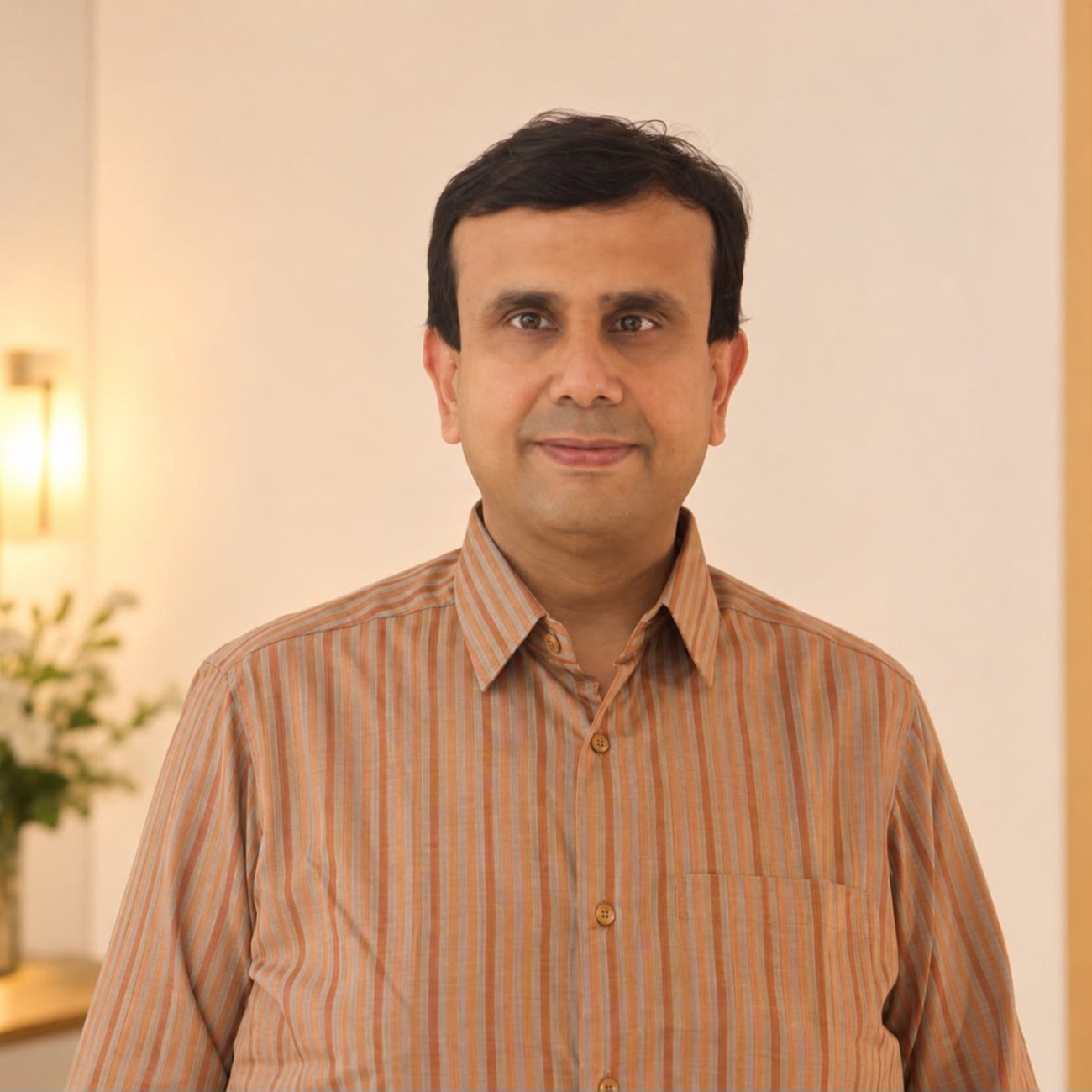
Ashish Goyal is a global macro investor whose professional and personal journey has been defined by navigating uncertainty, challenging conventional assumptions and operating across the intersection of markets, economics, politics and human potential.


About The Episode
Join us on The Founder Spirit podcast with Ashish Goyal, whose remarkable journey as the first blind trader on Wall Street is a testament to resilience and the transformative power of perspective. A global macro investor, his professional and personal journey has been defined by navigating uncertainty, challenging conventional assumptions and operating across the intersection of markets, economics, politics and human potential.
Ashish's life took a dramatic turn when he began losing his sight as a teenager. The path to acceptance and reinvention wasn’t easy. As a child who loved sports and dreamed of becoming a professional tennis player, he shares how meeting his guru changed his life, and how he went on to build a career in high finance. Don't forget to subscribe and support us on Patreon!
TUNE IN to this conversation & find out.
This episode invites you to reflect on what it means to build an abundant future while challenging conventional assumptions about disability. Don't forget to subscribe and support us on Patreon!
Biography
Ashish Goyal is a global macro investor whose professional and personal journey has been defined by navigating uncertainty, challenging conventional assumptions and operating across the intersection of markets, economics, politics and human behaviour.
Over a 16-year investment career, Ashish has managed portfolios at some of the world’s leading investment institutions, including J.P. Morgan CIO, BlueCrest and Citadel. His work has focused principally on global macro investing across interest rates, currencies and broader cross-asset opportunities. Having invested through markedly different economic and market regimes, he has developed a particular interest in how economic fundamentals, policy, politics, market psychology and positioning interact to shape both risk and opportunity.
Ashish lost his sight as a teenager, at a point when his education and future appeared profoundly uncertain. He subsequently rebuilt his life and career, graduating with an MBA from the Wharton School in 2008 as its first visually impaired graduate and going on to become the first visually impaired investor-trader on Wall Street.
Living and investing without sight has given him a distinctive perspective on decision-making under uncertainty: how to distinguish information from noise, build conviction without complete information, adapt when circumstances change and take risk without being paralysed by what cannot be known.
In 2010, Ashish received India’s National Award for the Empowerment of Persons with Disabilities from the President of India. In 2015, he was selected as a Young Global Leader by the World Economic Forum.
Beyond investing, Ashish has devoted considerable time to questions of inclusion, opportunity and human potential. He serves on the boards of the Vision Catalyst Fund, The Inclusion Initiative at the London School of Economics, Kilimanjaro Blind Trust and Rising Flame, and previously served on the board of Peek Vision Foundation. His interests extend beyond disability to education, economic opportunity and the institutional conditions that enable people to fulfil their potential.
Ashish has spoken at the World Economic Forum in Davos, the London Stock Exchange, Bloomberg in London and the Sohn Charity Conference, and his journey has been covered by international media including The New York Times.
Based in London, Ashish remains a student of markets, economic and political history, geopolitics and human behaviour. Across investing and life, a recurring question has shaped his thinking: how do we make good decisions, and continue moving forward, when we cannot know what comes next?
Episode Transcript
[00:02] Jennifer Wu: Hi everyone, thanks for listening to The Founder Spirit podcast. I'm your host, Jennifer Wu. In this podcast series, I interview exceptional individuals from all over the world with the Founder Spirit, ranging from social entrepreneurs, tech founders, to philanthropists, elite athletes and more. Together, we'll uncover not only how they managed to succeed in facing multiple challenges, but also who they are as people and their human story.
Our podcasts are shared freely with the public, and your generosity is highly appreciated as we decided to do away with corporate sponsorships a few years ago. Please consider supporting us on Patreon so that we can continue creating meaningful episodes with inspiring guests - that is P-A-T-R-E-O-N.com/TheFounderSpirit.
As always, you can find us on Apple, Amazon and Spotify, as well as social media and our website at TheFounderSpirit.com.
“As a blind person in India in 2004, there was no job for me. You encounter difficulties and what you do with life with those difficulties is what actually proves the mettle of a person, and the same thing for a trader.”
“If I hadn't gone blind, I wouldn't have met my guru. For me, that has to be the biggest gift I've ever got in my life. To find him, to have his hand on my head, to get his blessings, to get his guidance. I think life has been absolutely incredible because of that.”
“It has allowed me to reinvent life, restart life and challenge life, challenge the limits of everything I can do.”
Joining us today is the exuberant Ashish Goyal, a global macro investor whose professional and personal journey has been defined by navigating uncertainty, challenging conventional assumptions and operating across the intersection of markets, economics, politics and human potential.
Ashish lost his sight as a teenager, at a point when his education and future appeared profoundly bleak. Recipient of India’s highest civilian award for an individual with a disability, he subsequently rebuilt his life and career as an investment professional, a geopolitical thinker, student of Vedic sciences, and a champion for equity, justice and inclusion. And most recently, he became a father.
When I first met Ashish, I just knew that he was someone special. He has a great sense of humor and is incredibly intelligent, but what struck me most was the joy he radiated to those around him, and the ease with which he seemed to move through life.
Just how did Ashish manage to overcome losing his sight to become the first blind trader on Wall Street? Well, let’s talk to him & find out.
Hello Ashish, welcome to The Founder Spirit podcast! Thank you for joining us today - we are so pleased to have you with us on the show.
[03:15] Ashish: Hi, Jenn. Thank you for having me, and it's a pleasure to be here.
[03:19] Jennifer: Growing up in Mumbai, what was the young Ashish like?
[03:23] Ashish: The young Ashish was a very simple person. He was a happy child. He wanted to play sports; he was not particularly interested in studies.
Cricket was his game. Somehow for a young person in the early 80s in India, he fell in love with tennis and all he wanted to be was outside and play.
And the other thing was that his parents were very keen on making him study mathematics and science. So Ashish also became very good with maths very early in his life.
This is the Ashish I remember from the time before I started going blind. And then it all changed. But that was the first seven years of my life.
[03:58] Jennifer: So at seven years old, you were diagnosed with a degenerative eye condition. It would be a long, gradual process before you completely lost your vision.
So as someone who aspired to be a professional tennis player and someone before the age of two learned to swim, don't ask me how I know this (chuckles), but what were some of the personal struggles that you encountered over this long period of 12 years?
[04:26] Ashish: That's a whole different lifetime which I have either actively or unknowingly tried to remove from my head, because it was so long, so painful, and without being funny, it was so dark.
Like I just told you a minute ago, I was a happy child. I wanted to play, I was very practical. At seven, as an Indian kid, everybody wanted to play cricketeer and I had no chance. So I started learning tennis.
And those 13 years proved to be so long, so defining, and in some way quite destructive to me as an individual or me as a child and a teenager. I had to give up a few dreams as my life progressed and my vision decreased.
I started off trying to become a tennis player. Like I said, I learned tennis for four years religiously. After school I would go 15km away at that time in Mumbai, that was a long way away, and learn tennis every week, three times. But by the time I was 11, balls started disappearing from across the court. So I had to give that up.
Now, obviously I was still in school. So funnily, luckily, I fell in love with physics. And physics to me, made a lot of sense because it was very logical, it explains the world. The laws of physics made complete sense to me as an individual.
But I realized that as I was going blind and there was no chance in the 90s to study physics as a blind person. India was not set up for that. So I had to give up that dream.
And eventually I reached college. I had already gone through school trying to understand what it means to lose (eye) sight, what it means to not be able to see one part of my parents living room every month after the other.
And then I was put into this teenage life of being in college in India. College for me started at 15 because that's where undergrad starts. You know, I was amongst 5,000 other students. And this is where hope, future career, friendships, relationships, all of that comes together.
And all I was doing was… I was running very hard on the spot in order to let life not take me backwards, forget about moving forward. I remember feeling sad, obviously wondering what was happening, wondering why it was happening to me, but also literally seeing in front of me my future disappear, my dreams disappear, my relevance in the world disappear.
And one of the things that I've never spoken about before is a sense of shame that came across because I felt it was me, I was a problem. Of course there was something wrong with me from a medical perspective, but for me it was the other something wrong for me.
And by the time I was 18-19, lots of young people went out and did a lot of fun things. And I saw all of that disappear right in front of me, to the extent that I was so afraid, I was so not sure about the future and I was completely depressed.
As time progressed, my life became shorter, my world became smaller. And that was really difficult, to the extent that by the time I was 19, I thought my life was over.
And I actually remember this very coherently. There were many occasions where I would run into people and I had to say sorry, and they wouldn't understand why this guy can't walk straight.
I would fall under staircases, hurt myself, and nobody would come to pick me up. In fact, they would laugh at me because, why would a grown up 17 year old fall on the stairs?
I went into college with six friends. I came out with probably three if I am generous. And at 19, I went to my parents and I said, you know what, this is a nightmare. I will not finish my exams.
I had the utmost fear of failure. In fact, I was convinced that if I sat for my final exams, I would fail. And that failure would be a failure for me, my family, for everybody. I would bring everybody down with me.
And I went to my parents and I said, let's do a deal. Let me clean your house for the rest of my life and you feed me twice a day. That's all I need - give me some food, give me some shelter, I will not demand anything out of me, but please do not send me to college, please do not make me take my exams.
And that was the extent of my life. I thought my future was that. I never thought about suicide, to be very clear, but was I one degree removed from it? Perhaps, because I thought life was not worth living. And that was my life.
[08:54] Jennifer: Thank you for sharing that with the audience. Ashish, I have heard you tell the story many times, and this is perhaps the most detailed I've heard (of) it, so thank you.
So do you recall a particular moment of transformation, maybe perhaps a turning point in your life where you stopped being the victim and started living up to your potential? I know that you eventually finished your undergrad with flying colors. You were ranked number two in your class.
So obviously something kept you going despite this period of anger and grief and shame. So what was the moment of transformation in your life that made you have a complete turnaround?
[09:39] Ashish: If we had met for the first time, Jen, I would have said, you know, India has a lot of Bollywood movies. The hero always wins, so I had to win, right? I mean… (chuckles) but…
[09:52] Jennifer: You're a winner.
[05:53] Ashish: No, the fact that I came second in my class. But anyways, jokes apart, there is a very specific, transformational moment in my life.
Of course, my family was amazing - they never let me give up. I had two younger sisters, and the older of the two was quite phenomenal with her studies. She helped me study along with my parents.
I was very lucky. When I was 8 years old, my parents took me to an ayurvedic doctor - his name was Sri Guru Dr. Balaji Tambe. And I went to him as a patient. Because they tried everything as they realized that at 7, the child might go blind. Imagine, what went through them, so they tried everything for me.
And when we met Dr. Tambe, we also realized that he had a spiritual side to it. Obviously, my parents realized that. And that became the most important moment of my life in terms of how the future would change.
Fast forward when I was 19, we obviously started becoming a part of his family. We started going to him regularly and we started following him. And then eventually, at 19, when I was at the deepest, darkest moments of my life, my parents took me to him and he sat me down.
He held my hand for five minutes while talking to other people. And that was my first experience of energy healing. I mean, lots of people now do sound baths and energy healing and all kinds of things, but I experienced that in 1999 or 2000, I can't remember.
And then after those 5-10 minutes, when he did what he had to do, he turned around and he spoke to me and he said, okay, tell me what's going on. And I told him everything that was happening and how difficult everything was.
And he said three things to me. And those three things they've actually become an integral part of my life. He said, Ashish, that you've lost one of your senses - that's your eyesight. So the other four senses are working and they're working well. So if you think about a glass with water, your glass is 80% full - it's not 20% empty. And that perspective, you know, people talk about half empty, half full glass. I had an 80% full glass. That was never told to me like that before.
Second thing he said was, you have profound problems and you're trying to solve all of them, and you're trying to invent problems in the future and solve them now at the same time.
So let's take a step back. Let's start tackling all the problems that you have today, one step at a time. So take baby steps and see whether those problems will (be solved) or not. And don't worry about the problems that might or might not happen in the future.
You made me come back to the present. You brought me back to the here and now and how to deal with the challenges you have now in a way that you don't start catastrophizing the future.
And then the third thing he said was, why don't you start meditating every day? I was already meditating a little bit, but he said, no, seriously, start meditating every day and then see the power of meditation and how the universe responds. He said, but for that, you have to do it every day for some time to see how things change.
Guess what? I hadn't slept for six months, almost not more than an hour a night when I went to him, when my parents took me to him then. And that night I went home and I slept for 12 hours - I can't believe it.
Again, like a Bollywood movie, I would love to say the next day I woke up, everything was rosy and bright. No but I woke up the next day with the same fears, the same trepidation, the same nervousness.
But somehow the sun had popped its head through the clouds and I could see some light. And I said, okay, what if he's right? Why don't I just do what he asked me to do? And I started following those steps one by one, every day, religiously, meticulously.
I gave my exams after three months, which I was not ready to give - I got my class distinction. After a year of that, I was at a business school in India - I came second in my class. I mean, all of that, it's just. The dam burst open and the more I did, the same thing, the more things became better. That was the most poignant moment in my life.
[13:58] Jennifer: According to your sister, by the way, she said that was the moment. And then you never look back. It was like your life had completely taken a different turn.
[14:07] Ashish: I was told to stay in the present, so there was no reason to look back. And there's no reason to look back. (chuckles)
[14:14] Jennifer: Well, we are looking back a little bit with this podcast, though.
[14:18] Ashish: Yeah, I'm going into the depths of memories that I've not wanted to or had to go. Actually, I'm now enjoying them because it's been such an interesting journey.
I divide my life into multiple lifetimes. And at 19, after that talk with my Guruji, I think that's when my first life ended, my second life started. So for me, it's a new life, it's a new outlook, it's a new world. So there you go.
[14:46] Jennifer: Beautiful, beautiful. We're gonna go back to your Guruji, a little bit later.
But I want to explore this concept of fear, because most of us live with some degree of fear of the unknown. You had mentioned about catastrophizing the future - that, I think, is part of the human condition. That's what the mind is, and it's supposed to help us with survival.
But in the modern world, people have a lot of anxiety about the future, especially today. We're fearful (of) what is beyond our control, which are most things, and we're fearful about what we can't see coming.
You've lived through what many would consider one of the most fearful losses there is, but yet you carry on with an extraordinary lightness in your whole being, in your entire being. So in this journey, what did you uncover within yourself?
[15:43] Ashish: 18 months ago, I (had) the happiest moment of my life. It was the best gift I ever got because I became a father much later in life. But I did become a father.
And when my son was born, before giving the child to my wife, the doctor placed him in my hands, and I was elated. I was grateful, I was happy. But there was also this fear that every parent has.
How am I going to take care of this little bundle of joy? His whole being is dependent on me and my wife. And of course, my wife is amazing, and she does way more than her part. But I had to play a part as well, and I wanted to play as much a part.
Now imagine trying to do this. Every parent goes through this, but trying to do this with your eyes closed. I had to learn to be a father of a young baby who obviously needs support and care and all that. That was fear that came to me recently.
But again, talking about fear, I've had to live with fear from the time I lost my sight. But fortunately, since that day, when my Guruji spoke to me and I started doing those things. I started meditating. My life has gone on, and fear has kept going down.
Now, fear is a part of life. Now, that fear of thinking what would happen, because I don't see, I mean, those things have always existed. But the ability to deal with the uncertain, the unknown, is something I live with every day.
And my meditation, my belief, the learnings from the Bhagavad Gita, they have made me believe. They have made me learn how to deal with the fear.
So for me, as life has progressed, some people call me fearless, which is funny, because I don't think they understand what fears I have deep within me. But definitely my ability to handle fear is very different.
There's another example I want to give you. In 2017, I was working for Citadel. I went with my wife to Venice, and we took a gondola ride to our hotel. My wife went out, and the next thing I remember is I found myself probably 30-40 meters under the water, head down.
And that realization that something was wrong only hit me because I couldn't breathe. I was underwater. I started feeling the water around me. Obviously, I couldn't see where I was. I didn't know what happened.
The old me, before 19 or before 20, would have panicked, would have said, oh, my God, see, this is what life was meant to be. And I probably would never have come out. The new me, with all that training, that guidance, that meditation, realized I got a sense of what the situation was.
And all I needed to do is be in the here and now and say, okay, I need to find my way back up above water. And I swam back up with my laptop, with my stick, with my iPhones, everything intact. I didn't lose anything, actually. (chuckles)
And I came out gasping for air, but I came out. I swam to the edge, pulled myself out, hugged my wife. She was bawling, she thought she lost me. And the next thing I did was I checked the markets with her phone. Because I was managing money for Citadel - I had to be on top of that.
But that's what fear does. And we're living in a world that you can be afraid of so many things. But I think that meditation, that ability to be in the present and solve for things you can solve for and believe that the universe will do the right thing to you, helps allay the fears quite a lot.
I'm very grateful that I've gone from being this really afraid teenager to someone who cares a lot less about fear.
[19:32] Jennifer: Thank you.
I'm also a student of Vedic wisdom, and I think our thoughts can really shape our future. So for those listeners out there, the way to have a happy life is to have positive thoughts. Speak nicely - that will lead to honorable actions.
And that's what, I think, would make a happy life. It's actually a very simple formula, but many of us don't really understand that because we get lost in this material life because there are so many temptations.
[20:06] Ashish: This is the one reason why Jen and I became friends, because our thinking is so similar. And please listen to what you just said. I think if you just follow that formula, life becomes much simpler and easy.
[20:20] Jennifer: And you're the living example of that, Ashish. Really.
[20:22] Ashish: I don't know. I don't know about that, but I try.
[20:26] Jennifer: Yes, you are. For many of us, Ashish, you are a math whiz. You had mentioned that. That your parents pushed you academically. I understand that you can do mental math in your head like nobody else.
You also have this incredible superpower of reading the room. I have personal experience with that. It's like you don't see, but you really see. So in losing your vision. What do you think you gained instead?
[20:54] Ashish: I can talk about it from two angles, right? One is when you're different and you stand out. I mean, when you're physically different. Because I carry a white stick, I obviously don't make eye contact. I need help walking around.
So people already form impressions of you. I don't want to use the word “judge” you. I mean, I think they do, but still, I think I would not want to say judge you, but for impressions of you.
And you realize that we as humans make a lot of judgments or make impressions of other people without doing any real research or understanding of that other person or their situation.
And that has been the most fascinating thing for me. For me, not being able to see has spared me from making those judgments. I actually rely a lot on my listening and I rely a lot on my sensing.
Now where does that sensing come from? Maybe it's (from) the meditation again, maybe it's the way my brain works. Maybe that's how I'm programmed. And that allows me to look through the superficial outer layer.
Again, when I was single, going and talking to a beautiful girl, I didn't care because her beauty didn't make any difference. If she was interesting, that was good. If she was dumb, that was a problem. If she was arrogant, that was another problem. Or it is about listening to a friend or a family member or someone I've just met and hearing their voice and sensing either joy or sadness or I just get a sense of that.
Also because the non-verbal communication is missing. The non-verbal communication, a lot of that gives you.. people can put on an act but after a while the voice gives it away or the actions give it away.
Your question was?
[22:35] Jennifer: What did you gain from losing your vision?
[22:38] Ashish: That's one thing in my personal life. On the other side is, you know, I'm an investor and I mean whenever you've seen movies, I believe you would see a lot of screens and things moving around, and red lights and green lights and all things flashing.
I don't see all of that. So I don't get distracted. My focus is on the fundamentals. My focus is on what things really mean and how things should be. And actually not being able to see has been great for me from both personal perspective and trying to filter the kind of people I want to fill my life with.
And then also on the other side, when it comes to investing, the noise vs. the facts - that's allowed me to be a very good investor as well. Again, not to take away from the fact that I would have loved to see and maintain those things.
But maybe if Elon Musk is successful, I'll see one day and I hope I will not lose my other abilities though (chuckles).
[23:36] Jennifer: Ashish, for me you have a very strong sense of intuition, stronger than a lot of us who could see.
Just last week I went to a presentation where the fourth guide of the Heartfulness movement. I don't know if you know him, Daaji. He came from India to visit Switzerland and he actually traveled with a young child, 11 years old, who came from California.
This is going to sound totally woo to a lot of people, but I'm going to say it anyway. This child was blindfolded. And I know this is not staged because my friend who was literally sitting next to me, put three colored balls into his hands. And then with his blindfold on, he can tell exactly what the color of the ball was.
And it's interesting because when I asked him, obviously he's someone who still has his vision, but he was blindfolded. I asked him, I said, when you touch these balls, do you have a vision of the color in your head? You know, feel the vision? He's like, no, actually I can feel the vibration of the different colors.
So I think it's something that we under-develop in our current education system. Because we live in such a rational world that we've lost the ability to intuit a lot of times.
And as an investor, as you had mentioned, you're working with very incomplete information. You have to distinguish the signal from the noise because there's a lot of noise out there. And then you take calculated risks, right? So having a strong intuition, to project that into the future, is one of the critical skills as a trader.
But I was thinking back as you started out your career as a trader already in India and then on Wall street and then at hedge funds in London, I was wondering, how did you come to this decision to actually pursue a career in trading?
[25:37] Ashish: In the financial markets?
[25:38] Jennifer: Yes.
[25:39] Ashish: See, I already spoke about the two dreams I had to give up, that of playing at Wimbledon and then secondly becoming a physicist.
So eventually when I finished my college, I was doing accounting and economics, I was doing Bachelor of Commerce. And I loved physics because of the way it made sense of the world. And I thought macroeconomics did the same.
But there was something even more profound about macroeconomics. You know, the decisions that a government takes on growth, pending fiscal deficit, inflation, along with the central bank, affects real people and a large population. And that was fascinating.
We already spoke about )that) I love numbers. In fact, I had the ability of (seeing) balance sheets in my head. I did not need a pen and paper or a computer or whatever. So for me, it was just fascinating.
Also what I did not want to do was I didn't want to be an academician. With all due respect to the researchers and academics in the world, I respect them a lot. But my idea was, how do I make this into a practical job? And the only practical application of macroeconomics and numbers and mathematics and accounting was the financial markets.
So once I finished my first MBA in India, I interviewed with banks. I also interviewed with multinational corporations and Indian corporates and things like that. The only person who interviewed me was ING Bank. Everybody else just threw me out of the process because I was blind.
And when I went to that process, Dr. V Raghunathan, who was the chairman of the bank at that time, interviewed me. He was an ex-professor of IIM (Indian Institute of Management) Ahmedabad.
And after the interview, he said, Ashish, you're the only one who's got all my questions right - very technical questions around bond mathematics and duration and convexity.
And he said, what do you want to do for my bank? You know, I was cheeky. I said, I want to be a trader. And he was the chairman of the bank - he didn't run (the) treasury, he didn't care. He said, yeah, you can be a trader for my bank. And that's how I started off there - I spent two years there.
Someone made a mistake by giving me a job - nobody else wanted to touch me after that because as a blind person in India in 2004, there was no job for me. And in that process, someone told me, why don't you go to Wall Street? And I laughed at him. I said, from Mumbai to Wall Street - being blind, I mean, how does that work?
Eventually I realized it wasn't that cuckoo of an idea. And I ended up figuring out that going to business school would be the best way to go to Wall Street. I applied to Wharton and Chicago and both of them gave me an admission. It was an easy choice to go to Wharton if you wanted to go to Wall Street.
So what I didn't realize, when I reached Wharton, I went very happily to Wharton wanting to carry the dream of being on Wall Street. And then once I reached Wharton, I realized when I started interviewing with banks that there was never a blind person on Wall street before.
And that became like going from the devil to the deep sea. And that literally disrupted my thought process for a minute. But then what was I told? I was told that you need to live in the present. You need to solve the problems you can solve for and let the universe take care of things for you and your meditation take care of things.
I did exactly that. I banged on every door of a bank. I faced a lot of interesting ways… I said in India they would just throw me out of the process. Obviously in the US they couldn't do that.
But then I remember a European bank interviewing me for 45 minutes only on leadership and HR and teamwork. I mean, there was not a single financial markets question. And then obviously I never went through the second round.
There was an American bank that doesn't exist that said we're XYZ bank, we are very equal to everybody. And then, I mean, I got all the questions (right), they didn't take me forward.
Eventually JP Morgan gave me an internship in London. (The) first day I came to JP Morgan, they said, hey, we've given you an internship, that's great - you should use this internship to find another job afterwards, we don't have a job for you.
And I said, wow, amazing, the only bank that wants to touch me says they don't have a job for me. Then I put my head down, I kept going for eight weeks. Eventually, Dax Catham introduced me to Bill Winters, then number two at the bank. And Bill Winters made me interview with everybody else and then they took a call on me and made me a prop trader. That's my journey to Wall Street.
But more importantly, why the financial markets? Because I think of financial markets as a puzzle. Every time something moves in the world, it impacts the financial markets. So for me, I'm solving a giant puzzle with moving parts every day of my life.
And what more intellectual high can one get? What more fun can one have in trying to make sense of this ever-moving complex world which has so many variables, non-human variables and human variables that make a huge difference.
And for me, I'm living the dream as I try to make sense of the world and invest money. So that's why the financial market.
[30:35] Jennifer: So I don't know if you know this, Ashish, but I had a summer internship at a Wall street firm between my first and second year of business school.
And I remember the one of the first things that they told us, the internship class is to always be a student of the markets. And there's a saying on the trading floor - “the market humbles everyone eventually; and ego tends to be the most expensive thing that a trader can carry with them.”
So I was wondering, what was your most humbling trade and what has the market taught you about personal ego?
[31:16] Ashish: When you want to be in the financial world, in the markets or banking, people ask you to read a lot of books. There's Barbarians at the Gate, there's Liars Poker. And there was one title that made me chuckle - it said More Money than God right?
Now, that gives you the sense of ego or sense of self-righteousness or whatever you want to call it. Because when you make money, you're on this high that I don't think any substance can match that.
Also, you said that you were asked to be a student. Even today, when I interview with people or chat with people, I say I'm a student of macroeconomics and geopolitics because I don't think I can be an expert in this life at least. It's so huge, so vast, so fascinating, so beyond me or anybody.
And the same if you see, if you talk to Roger Federer or Rafael Nadal or Djokovic or anybody, they will never say we are the experts of the game. They'll always say we are lifelong students of the game.
Because that's what it is. If you want to be good at something, you need to keep getting better at it. I mean, there are too many, if I start telling you the trades that build up, right?
The one that stands out though is 2022. I'm not breaking any confidentiality or anything by revealing any specific trades, but I got the inflation picture wrong. I did not expect inflation to go up so dramatically the way it did after Covid and after the Russian invasion of Ukraine.
For me, I underestimated that. And that was one of the most costly experiences of my life. And that's fine, I learned a lot. You know, as a child, you start learning at the age of zero and then you keep learning as a human being till you die.
So for me, that was an experience that taught me so much about markets and investing.
[33:06] Jennifer: I have a friend who used to be an FX trader on Wall Street, and he told me that in his second year as the FX trader, he lost $5 million in one trade and he thought he was going to lose his job. So he went to his boss, was like, ready to resign or to be fired. And then the head of the trading desk is like, okay, this was your lesson. Now go make twice as much money back to prove your worth.
[33:32] Ashish: So one of the other things on Wall street is that lots of people don't trust you if you've not lost money in your life, because it's easy to make money when you're making money and then think that you're great.
But the real test of an investor or a trader comes into focus or is tested (when) they lose money. And whether they can come back from that.
And that is relevant even in human life because if you're born in relative resourcefulness, you're healthy and happy, you go to the best school in the world and all of that, of course you will succeed. But if you encounter difficulties (in life), and what do you do with life with those difficulties is what actually proves the mettle of a person, and the same thing for a trader.
So I'm not surprised your friend had that experience. And I've been lucky that I had another experience like that early in my career. And from there I had a clean, straight run of 10 years of solid investing. And I was happy that I learned a lot from that time of losing money as well.
[34:36] Jennifer: So I want to go back to 2016 just to continue with this theme a bit longer.
I understand you put on a contrarian trade with the view on Brexit that it's going to happen against the belief of many of your colleagues at the time. And of course, you turned out to be right. What gave you the confidence about Brexit and why do you think no one else saw it coming?
[34:57] Ashish: Again, see, I grew up in Mumbai, right? It's divided into South Mumbai and North Mumbai. And people in South Mumbai, they used to think they were all of Mumbai and they were all of India. And that was obviously wrong because that was a small, tiny population of the whole country or the whole city.
The same thing happened in 2015-16 in London. David Cameron, who was running a great government, I think a very decent government, but what made him come up with that Brexit word, I have no idea. And that made me very curious and that made me focus on it a lot.
And I could see a very apparent paradox or a conflict between London and outside London, because if you went to Mayfair or you went to, I don't know, Kensington, people were so pro-Europe, so bullish on Brexit not happening.
And the moment you would read anything outside, go to York or Manchester or talk to people there or listen to them on interviews on radio, you would realize that, oh, no, this is a different world out there.
So for me, I started mapping those divergences. I started realizing that the sentiment was very strong and people in London were living with blinders on or living in their own bubble, which is fine. I mean, it's okay to do that when you don't have such a big future changing question in front of you and you can get away with it.
And there was a particular moment which I remember as a Young Global Leader with the World Economic Forum, we get a lot of privileges. One of them was to go listen to Prime Minister Cameron at the Mansion House in May 2016, a month before the Brexit vote.
And he made a very eloquent, very powerful speech explaining why we should not leave Europe. All the numbers were there, the damage that could do, the benefits it brought by being in Europe, all of that was there.
And it was a very impressive speech from a presentation perspective, probably 10 out of 10, along with his charming way of delivering it. Right. I mean he knows how to speak. So.
But then afterwards he was doing the rounds and I met him and I said, sir, I'm an investor, nice to meet you, but can I say something? He said, sure, tell me. I said, great presentation, but you're going to lose the vote.
And he obviously was stunned for a second. And I was like, wow. I mean, did I just say that to the Prime Minister? I said, yeah, but. And he said, but why do you say that? I said, because you're explaining away emotions with statistics - the world doesn't work like that. I mean, I didn't say the world doesn't work like that to him, but in my head I was clear. And he said, well, we'll see what happens.
And we all saw what happened. I was very sad for the UK, but I was very happy for my investing because I was extremely bearish on the Pound. You know, I've modeled myself on George Soros as an investor. And he broke the Bank of England. I don't think I broke the Bank of England, but I made money on the Pound, being short on Pound.
[37:50] Jennifer: Now we know what the trade was.
[37:54] Ashish: When I joined JP Morgan in 2008, I joined the prop trading desk. My boss sat me down, he gave me three things to remember and the two things I've forgotten, I can't remember what he said.
The third thing was the most amazing thing anyone has ever told me about investing. He said, Ashish, you can be long, you can be short, or you can be in cash. That is you have no position.
And I have used that third thing of having no position so many times and I've saved myself so much money by not being long or short. So this question I take the third and decide not to have a position.
[38:32] Jennifer: Thanks. Well, I think I've learned that sometimes the best trade is no trade.
[38:37] Ashish: Yeah, that's exactly. That's a different form of what he said. So cash or no trade is exactly.
[38:43] Jennifer: Well, and also sometimes the best reaction is not to react Of course, in that moment of reacting, it feels good. But in the long-run, it may not be the best solution to the problem.
[38:55] Ashish: I cannot agree more with you.
And the technique I use as I've grown older, is to send my reaction to myself. So I either email me what I want to write to someone else, or I send myself a voice note on WhatsApp.
And the next day, if I still feel that was the right thing to do, then I kind of send that email or that voice note to the other person. That allows me that 24 hours of pondering on it and not having an instant reaction.
[39:25] Jennifer: Great. I want to take our conversation to a different direction towards your spiritual guru and the Vedic teachings.
You had mentioned your spiritual guru, Dr. Balaji Tambe, who was a very famous Ayurvedic doctor and someone who's very near and dear to your heart. So, Ashish, I what was Dr. Tambe like?
[39:47] Ashish: I think we'll need a lot more hours in this podcast or a lot more podcasts to describe that, but let me give it a shot.
For the world. He was one of India's leading Ayurvedic doctors. He was a spiritual person. He had disciples all across the world. He was an engineer by training, but he also learned the Vedas. He was a scholar of the Vedic sciences.
He was someone who taught the Bhagavad Gita. He also was an artist, has a lot of paintings that can be seen in a few different places in Pune. He was a musician. And on Spotify, there are at least 12 of his albums on different Vedic chants and mantras and healing and meditation. He was an author, he's written more than 50 books indian languages, a few of them in English, I think, Jen, I gave you a couple of them.
I mean, I can keep going, but for me, who he was.. He was the most important person of my life. And I say this, my parents knew this, my family knows this, everybody knows this because he was the person who made me who I am today.
And I'm very happy with who I am today. He took that lost soul at 19 and changed his life. He, for me, was a person who cared about the world, who came to do good in the world and basically lived life the way I would want to live my life.
He was thinking about everybody all the time.He was giving such positive energy to the world, and he made such a big difference to so many people. And that's what he was for me. He was the one person who made sense of everything in the chaos of the world for me.
I just mentioned I became a father 18 months ago after a lot of effort, a long time. We were blessed with this baby. And I cannot believe anything other than the fact that wherever he is, he still blessed us with this baby. Otherwise we wouldn't have this child.
[41:55] Jennifer: Beautiful. I was wondering if you could explain to the audience what is this relationship that binds the disciple to the guru? Because we don't really have that in the West, and I think it's very difficult for people to understand.
And that's also something that I had asked some of my friends with gurus. And I said, well, how do you know when you meet your guru? So, please, I have my kind of read on this, and I love for you to share, like, what is this relationship? Why is it so special?
[42:29] Ashish: When you ask people who've been in love for 20-30-50 years, how did you know you fell in love with this person? I don't think they can explain that. So the disciple-guru relationship is something similar, not from a love perspective.
When you come into someone else's energy and, thanks to people in Stanford and other places, you know, it's cool to talk about energy now. The first time I heard about energy was in the 80s when Guruji was talking about it and all of that.
So when you come across an energy that just makes sense, it's someone who you can surrender to, someone you can trust, someone you can rely on, someone who you know will take care of you. And you just vibe with that energy, you gel with that energy. That's what a guru-disciple relationship is.
Now, there are a few things, right? In today's world, we love optionality because we can walk out of anything, anytime. In today's world, the self is the whole and soul. In today's world, it's all about me and I.
But that's not what Eastern philosophies are about. I grew up in the East, in India. There are other countries in the East, you know, Hinduism, Buddhism, whatever you want to call it, Japanese culture. There's always a sense of community and there's always more than (meets) the eye.
And for me, that's what the relationship is, the guru finds you. Really. I mean, that's what I've understood, that the guru chooses you because he sees a soul that he can help and who he can help progress in this life for the next life.
And so that relationship is of complete surrender and complete trust. And it's not like you prove something and then I trust you. It's you trust someone and then you see what happens.
I don't know if I answered your question, but that's my raw emotions about the spirit, the guru and disciple relationship.
[44:29] Jennifer: Dr. Tambe, he did write a book, including one that you gave me called The Untold Secrets of Life. So as his disciple, what are the untold secrets of life, Ashish?
[44:42] Ashish: They're actually much simpler than we make it to be in this complex world.
See, there are two principles, right? One I've already spoken about (BG 2:47)
karmaṇy evādhikāras te
mā phaleṣu kadācana
That is, keep doing your job and the results will follow. You might not understand the results, but they'll follow - that's one.
The other one that I think if all of us imbibe even a little bit of this, we spoke about the self, we spoke about the I. But here's what I was taught by him, and it's very simple.
It said, every action you do, if you keep in mind yourself, your family, your society, your community, your country, your world and the universe you live in and make sure, that action is beneficial for everything, everybody and everything, rather than just yourself, then it's not a selfish action. Otherwise, if it's only beneficial to you, then it's a selfish action.
And imagine if that became universal, how many things would change in the right direction? You and I both understand how maths and science works. It's not a linear move, it's an exponential move. It's a virtuous cycle.
And that's what the teaching is: a) live a principled life, do the right thing, the universe will take care of things, but also live a life that's not selfish. These are some of the things that he said which are the secrets of life.
The final thing, which I have worked with all my life is don't stand for injustice, as in stand against injustice, and don't be afraid of that. Because both personally and professionally, there are various times where I've stood up and spoken my truth.
Not everybody likes it all the time, but if I don't stand up, who will? Because that's how I think about it. And honestly, if you're on the side of being right, I don't think you should worry about standing up for the right thing. Of course you have to do it tactfully sometimes and all that, but you can't be silent.
Those are some of the principles. And if you just follow those, life becomes very simple, at least that's my experience.
[46:50] Jennifer: Thank you. Ashish, you just quoted from the Bhagavad Gita, the part about Karma Yoga. I think it's from chapter two.
[46:58] Ashish: You know, you remember these chapters way more than I do…
[47:01] Jennifer: I think it's from chapter two - actually used to be my favorite verse about Karma Yoga.
You know, I've had various people on the show that have talked about the Bhagavad Gita that follows Vedic science. It's been given to me or transmitted to me that the Bhagavad Gita is a manual for life, but it's also a love letter from God.
So I was wondering along similar lines, what is the Gita to you?
[47:27] Ashish: I think I'll define it in the first way. It's the principles of living life.
Because when Arjuna is standing in the middle of the field giving up arms and wanting to surrender, not being able to choose a side because of his material relationships with his cousins and relatives and all that. And when Krishna, Lord Krishna, tells him to do the right thing, it's not about that specific moment of that war. It is about life and how we need to not let fear affect us.
We need to stand for the right thing. We need to do our role, whether it's karma yoga, dharma yoga, or whether it's when it comes to your family life or however. So for me, it's the basic principles of living life. And that's how I think about the Gita.
That's what I've understood about it. And it's a very simple book. It's the most complicated book. Quantum physics is easy sometimes, because the amazing thing about the Gita is that if you read it 100 times, you will come back with new learnings every time you read it.
So for me, it's a source of inspiration. It's the truth about life. And it's more than anything is the principles of living life.
[48:39] Jennifer: Beautifully said. I think for me, the Gita, when I first read it.. I just picked whatever the most popular book was on Amazon. (chuckles)
Even though I understood very little, what I understood is that it is the truth. It's the truth for me at least, and that's why I'm really drawn to it. But I also understood that I really didn't understand very much.
And so that catalyzed my journey to start looking for teachers that can actually explain this to me, like the real teachings behind the story and the dialogue, the conversation between Arjuna and Krishna.
The other thing I want to mention is that you had said that Gita has so many layers. I think I definitely feel the same way. I feel like it's a book that I can go back to, keep reading and rereading over time. And I think depending on your level of consciousness at the time when you're reading it, the depth of the wisdom unfolds.
[49:40] Ashish: 100%. You said it so well. Right. Because your experiences, your mindset, your emotions color the way you read it and what you understand from it.
I mean, I've been in a room where there are 50 people and a shlok, a verse from the Gita has been read and the interpretation has been read, almost everybody… made sense to their respective situations or to their moment in time.
And that's the power of the Gita. That's why, like I said and you said, it's… It almost feels like it's the truth.
[50:09] Jennifer: Ashish, you've experienced in life, one hand, extraordinary recognition. At age 30, you were honored with India's highest civilian award for an individual with disability by the President of India, as mentioned.
But on the other hand, you must have also experienced rejections in some encounters in your life because obviously we talked about that in terms of trying to get a job at banks. So they see a blind person and they don't even bother.
So we all experience recognition and rejection in some form. But I think for you, this must be quite poignant. So I was wondering, how have these contrasting experiences shape the way that you see the world or the way that you see people?
[50:55] Ashish: Jen, that's a great question. You know, we live in a world of duality. When there is a North Pole, there's also the South Pole. When you have a positive charge, you have a negative charge. Where there's day, there's night.
When you want to judge a person, it's very difficult to see black and white in a person. A person can be really good in something and really bad in something or could be a really amazing person for someone and could be a really horrible person for someone. I mean, I'm not saying everybody.
So there's a spectrum and there's duality, and highs and lows are a part of life in the same duality. Rejection and acceptance is a part of the same life. In fact, you know, there are two emotions that people talk about a lot, sadness and happiness. What the Gita teaches you is, and that's what Sri Guruji used to say, is that you don't need to be happy or sad, you need to be content.
Because he used to say that, if something went right today, that's great. If something went wrong today, that's great because there must be a reason for that. And you can keep doing what you need to do in life. Of course, you alter your life according to the results.
But that has been something that I have been taught from the age of 9 or 10 or 11, whenever I first got proper consciousness as a child. And I have seen it work beautifully.
Also, rejection is as big a part of life as acceptance needs to be. I remember I got rejected by tennis; not because tennis didn't like me because I went blind. I got rejected by physics because I couldn't study it. I thought life was rejecting me at 19.
But then because of that, I met my guru. Because of that, the family came close together. Because of all of that, I ended up changing as a human being.
When I started the second life at 20 and I became this new person, I did not have the fundamentals of being a child or a teenager. I hadn't learned or done or experienced the things that a child and a teenager does in the way that the rest of the world does.
But at 20, I had to become a 20 year old. And when I went to Wharton at 26, I had to be a 26 year old who had come from India in an international environment that I'd never been to before.
And now at 46, I have to be a 46-year old father without having the fundamentals of being a child or a teenager. And I often wonder what that would have been like if I had those experiences like every other person or a regular person. I don't know.
And maybe that's why I'm different. Maybe I don't always fit into a lot of things, but maybe that's why I attract so many people. I have no idea. But that's the duality I've lived with.
And the funniest example of this is obviously because I went through what I went through in my young age, I hadn't dated anyone. When I graduated, I became a prop trader. I said this was the perfect time to come to London and start going on dates.
I used match.com, e-harmony, all of that. And I sent out 300 messages. I don't think my wife knows about this, but she will discover through the podcast. And I got 300 rejections, which is amazing, because if that wouldn't have happened, I wouldn't have met my wife. And meeting my wife was one of the best things that happened to me.
So for me, I don't see rejections as anything dramatic. I don't see acceptance as, oh, wow. When I became a Young Global Leader with the World Economic Forum, of course I was very happy. It was a big recognition. But did that change my life? Did I get a chip on my shoulder or did I get extra horns? No, I mean, I was the same Ashish.
And I still remember a very specific example that I heard from. I think it's a story from Indra Nooi, the ex-CEO of Pepsi. She said the day she became the CEO, she came home running to her mom and said, mom, I become the CEO and such great news. And her mom said, that's okay, but there's no milk in the house, can you go get milk, please? (chuckles)
And for me, that's been my life. Whatever I've achieved, when I come home, I'm the husband, I'm the father now; I'm the brother or the child. Unfortunately, I lost my dad a few years ago. But yeah, with my friends, my school friends, I'm still the same guy.
I remember in 2011, I had gone to Singapore for work. There's that. It used to be Coup d’Etat, now it's called C’est La Vie. The rooftop bar went out in the evening. Some bank took me out as a client. It was funny - I experimented with something.
There was a group of girls dancing. I think the salesperson took me and we were dancing. And one of them asked me, what do I do? I experimented with something. I said, I'm a tango teacher. (chuckles) And for the next 20 minutes, I taught four girls how to dance tango.
I didn't need to tell him I was an investor, who cared? When I'm in my professional garb, I'm a serious investor. A lot of people who've dealt with me will realize that I have very strong opinions. I question a lot of things because I want to know the truth.
But when I'm outside that role, I'm not anybody else. I'm a simple, happy guy who wants to live my life and, be happy. So for me, the duality, the appreciation, the rejection, it's all a part of life. You do what you can; the rest, accept it as it is and don't take rubbish from people.
[56:17] Jennifer: Well, I can assure the audience that everybody that Ashish is good friends with is a good person. So, yeah, myself included, of course. (chuckles)
You know, there's something to be said about the people that you attract or the people that become attracted to you, I think, because that they could see beyond the physical disability, and see you as truly who you are.
[56:43] Ashish: You know, I've been on a sabbatical and one of the best things that happened is automatic filtration of people because I don't have the title, I don't have the role. And those people who wanted something from me because I had a job or they thought I could get them something or connect them to someone.
And it's been the most amazing thing that a lot of old relationships and connections have been lost, but a lot of amazing new ones have been formed. Just like you. I mean, you and I met randomly at a lunch, which we wouldn't have even spoken at if I hadn't forced myself to move it to the middle of the table, so…
[57:22] Jennifer: I'm really glad you did. I was intrigued. (chuckles)
Something else I want to say - there's a couple of reactions that I have to what you just said. Like contentment, that's a marker in my life, if you can put it this way.
I think sadness and happiness comes and goes, and it's part of life. But contentment, this is also something that I think the Gita talks about, which is equanimity.
This concept of equanimity, although it's not the same as contentment, but (have) equanimity when things are going right for you, and have equanimity when things are not going so well.
Of course it's natural to be elated when things work out. And it's also very natural for a person to be angry and sad or depressed or disappointed when things don't really work out.
It's only when you have that bigger perspective, maybe like six months from when the incident happened, or a year, then you could really see that whatever happened to you, whatever difficulties or whatever obstacles that you had encountered is actually a big gift. Because it's an opportunity for personal growth, for spiritual growth. But at the moment it's just really hard.
Well, the other thing I want to say is your sister had asked me specifically to ask him what is his motivation behind learning how to tango. And I said to meet girls, of course. (chuckles) I think that has been partially validated.
[58:59] Ashish: My answer to that question was very simple, such a beautiful movie - Scent of a Woman. I just wanted to mimic Al Pacino. That was my safe answer.
[59:07] Jennifer: Nice, and it's also a movie about a guy who's blind. For those of us who are old enough to know what the movie is. Scent of a Woman by Al Pacino.
Ashish, I've gotten to know you over the past few months and what I've realized is that your incredible journey isn't simply about overcoming blindness, but it's actually challenging what the world believes is possible. So what do you think the greatest gift losing your vision has given you?
[59:36] Ashish: That's an interesting question. And I have two different chains of thoughts here actually.
So the straightforward answer is this, that if I hadn't gone blind, I wouldn't have met my guru. For me, that has to be the biggest gift I've ever got in my life. To find him, to have his hand on my head, to get his blessings, to get his guidance. I think life has been absolutely incredible because of that. That's my straightforward answer.
But if I think about it philosophically a little bit. It's not only blindness, but also defining spirituality along with blindness. So the yin and the yang, the negative and the positive charge at the same time. I keep going back to the duality. It has allowed me to reinvent life, restart life and challenge life, challenge the limits of everything I can do.
[01:00:27] Jennifer: I've watched how you navigate through life with so much with great ease, and everyone sees you smiling and being very cheerful all the time.
But do you think, does the world see you because you put in so much effort into your day to day life just to make life seem seamless for the rest of us? Do you think the world sees you?
[01:00:51] Ashish: The honest answer is probably a handful of people. There are a few different layers to this.
People see me smiling because I want to be happy, I want to make people around me happy. And I like being happy. I like being content. And I'm interchangeably using those words. I like smiling. I think it's a great place to be for yourself and for others.
But all these situations that I'm put into, whether it's work or personal, there's a lot of pre-planning and effort that goes into anything because it's not the same. I can't just walk up to a place and you say, oh, the venue has changed, go to the other place.
A couple of times I've had to go and scope a place before I've gone to do something there or whatever. So there's a lot of planning that goes into it.
Obviously my blindness is a part of me. It's not something external to me, it's not something internal to me, just a part of me. And that causes a lot of challenges. Even today, even though I'm not afraid of them anymore, I'm okay with what they are.
And one of those challenges is loneliness, because you might be in the midst of a 5,000-person crowd, but you can still be lonely.
And for example, I did this fundraising three months ago, four months ago, I was shocked. I got 400 people donating. And those are the people I communicated in the last four years, not the people I (have known for) all my life - I didn't even reach all of them.
But what I'm trying to say is that there is a me that loves people, that loves chatting with people, loves getting to know people, loves helping people. Whether it's my family, friends, people from my network, I'm always there. If someone comes for help, I would 99% of the time say, okay, let me see what I can do and really try and help.
But when it comes to me, I feel quite alone still. A lot of times some of my closest friends are not in London. I talk to them regularly on the phone, etc. But also some of them have moved out of London. So yeah, it's a lonely place.
Also, people talk about being vulnerable. When I used to do these interviews or podcasts or television or paper interviews, till six years ago, it would sound like a story which was like, all great, all happy, all hunky dory, like happy ending, blah, blah.
Now I started talking about these real emotions quite a lot because I realized that people connect with people who have vulnerability. They don't connect with superheroes. So yeah, I'm not a superhero. I'm a very ordinary guy. I'm as ordinary as anybody else or more actually.
What I've also realized that in one-on-one conversation, (I am) vulnerable. And (if) people don't reciprocate, I get disappointed. And I know disappointment is not something that the Gita teaches. And that's why I'm more and more vulnerable. I still think there is a lot of space in my life for those individual relationships that can be stronger and all that.
Sorry, Jen, it's your energy that has made me be so honest about everything.
[01:03:52] Jennifer: I appreciate it. I think it's in the vulnerabilities that we discover each other, that we see each other - it's really important.
And also I've had these transactional relationships where in my previous incarnation, it's about what I want from the other party. And now it is like, how can I help you in your endeavors?
So there's certain karma that's being created when you're able to be very authentic and you want to serve others. People come back and they help you. And I think life is all about creating these authentic connections.
And because it's natural to be human, to want to be loved and to want to be connected to each other.
[01:04:36] Ashish: Two quick things I want to say, I won't take too much time.
So I used to tell people that when I walk into a room, either people look up to me, that is idealize me or ignore me or look down on me. And people are like, oh, so which one who you're okay with? I said, I'm not okay with all three of them. I just want to be another person in the room, like, being treated equal.
And the second thing - you spoke about authenticity. You know, in the last six years, perhaps or seven years, I've realized life is short. I already started life at 20, so I lost 19 years before that, but my life doesn't get extended by 19 years.
And with my child and with losing my dad and then my guru, I realized life is too short. So now what you get is 100% authentic Ashish. If you don't like it, that's your problem. (chuckles)
[01:05:30] Jennifer: Well, we like this Ashish.
So you left your hedge fund career, what's now next for you? Are you going to go back to being a trader again? Or are you going to start the third chapter of your life?
[01:05:46] Ashish: My third chapter started when I became a father. So that's already started, that has nothing to do with my career.
But I am in conversations with some people, who know where that goes. See whether I'll be an investor in the future, I mean, I will be always a student of macro and geopolitics, I will be always in the financial markets. In what form I don't know whether it might be just on the personal side, because once you become a macro guy, at least for me, you breathe the macro till you die. There's no question about that.
I have too many interests, I care about too many things. So what role, the next one I will be, I have no idea. I'm open to a lot of things. I would love to be an investor again, but if it's the right time, right place, it'll happen. If not, I'm sure I'll make myself useful to some other people some other way. But I will always be connected to the markets and macro and geopolitics.
Actually, you know, there's one more thing. I've been asked this question about my future multiple times. When I've achieved something, when I've changed jobs and I became a Young Global Leader when I graduated. And if you were an investor who was investing with me, based on how I predicted my future, you would lose money every three years.
Because I've never been able to guess what my life would look like three years forward. I think I stand at the same juncture and I'm very comfortable with that because I know I'm doing my bit and my guru and my universe will take care of it.
[01:07:16] Jennifer: Wonderful. I have a few rapid fire questions so you can answer them in short format. Nadal or Djokovic?
[01:07:25] Ashish: Sorry? Nadal or who?
[01:07:27] Jennifer: Djokovic. (chuckles)
[01:07:29] Ashish: I think I'm happy to say this. I read his book, I saw his documentary.
There has never been a better sportsperson than Rafael Nadal. The way he had dealt with injury, the way that the concentration, the discipline, the hard work, the tenacity, the intensity. It's my dream to have dinner with Rafael Nadal. I would love to meet him.
Sachin Tendulkar was my friend and inspiration as I was growing up. But I don't think there's a better tennis player or a better sports person than Rafael Nadal.
You know, I've always been the underdog wherever I've gone and people have underestimated me. What have I done? All kinds of things.
Nadal was the same. Nobody gave him a chance. Two Wimbledons, two Australian Opens, four US Opens, 14 French Opens. That too with a foot that after his first French Open he was told he could never play again perhaps. I can keep going on Nadal.
[01:08:26] Jennifer: But there's a lot of love for Nadal right now. Okay. So we'll make sure to send it out to him. If money was not an issue, how would you like to contribute to society?
[01:08:36] Ashish: That's a question that opens up a Pandora's box. Because it's difficult to imagine if money was not an issue.
Because it's a rapid fire, I'm going to tell you this quickly. I would like to affect change. I would start thinking as an investor and affect change, first of all in places where it's easy to get quick and solid returns.
Secondly, then go to places that get ignored. I mean, for example, as a disabled person, people say there are 15% disabled people in the world, but it's not one comprehensive group. It's so many different forms of disabilities and people and it's not an economically powerful group.
So there are so many things like blindness, at least people are working on. There are so many small issues that nobody cares about. And imagine even if a little bit of help there could make such a big difference.
Again, going back to the principle of we all doing a little more than we already do, how that impacts the world in a better place, I would just try and make this world much fairer, much more level playing field. .
[01:09:41] Jennifer: Wonderful.
We're now coming to the end of our interview, and as you know, we end every episode with a quote. And for this episode, we have a quote from Mahatma Gandhi, an Indian lawyer, anti-colonial nationalist and political ethicist:
"Strength does not come from physical capacity.
It comes from an indomitable will."
Ashish, thank you so much for coming on the Founder Spirit podcast and sharing with us your journey and inspiring us with your wisdom and your resilience and your indomitable spirit.
[01:10:19] Ashish: Thank you Jen for having me. It was wonderful chatting with you and I have to be careful. You've got so many things out of me that nobody else has, so…
[01:10:31] Jennifer: Thank you, thank you so much. (chuckles)
Our podcasts are shared freely with the public, and your generosity is highly appreciated as we decided to do away with corporate sponsorships a few years ago. Please consider supporting us on Patreon so we can continue creating meaningful episodes with inspiring guests - that is P-A-T-R-E-O-N.com/TheFounderSpirit.
As always, you can find us on Apple, Amazon and Spotify, as well as social media and our website at TheFounderSpirit.com.
[01:11:03] END OF AUDIO
Show Notes
Personal Links - Social Media:
- Wikipedia: https://en.wikipedia.org/wiki/Ashish_Goyal
- LinkedIn: https://www.linkedin.com/in/ashishgoyalwg08/
- Instagram: https://www.instagram.com/ashishgoyal2804/
- WEF: https://www.weforum.org/people/ashish-goyal/
Dr. Balaji Tambre - Padma Shri Shreeguru Dr. Balaji Tambe, founder of Atmasantulana Village and Santulan Ayurveda, Karla, Maharashtra
- Spotify — Dr. Balaji Tambe - https://open.spotify.com/artist/4E7rppDJJIWxCliET8IDjc
- YouTube — Shreeguru Dr. Balaji Tambe (main channel, linked by Santulan Ayurveda) - https://www.youtube.com/channel/UCYXn_jH9iacFT2Hwiq_3ydA/videos
- YouTube — Shreeguru Dr. Balaji Tambe (Hindi channel) - https://www.youtube.com/@shreegurudrbalajitambe-hindi
Books:
- The Untold Secrets of Life by Dr. Balaji Tambe - https://a.co/d/0arlG9Fm
- Dr. Balaji Tambe on Amazon.com
Media Links:
- Indian Express — The Indian Who Manages Risk for JPMorgan, and Blindness - Dec 2010
- Managing Risk for JPMorgan, and Blindness - NYTimes - Dec 2010
- http://dealbook.nytimes.com/2010/12/02/managing-risk-for-jpmorgan-and-blindness/?utm_source=chatgpt.com
- Economic Times — Bullish on India: Ashish Goyal, CIO, JP Morgan - Jan 2011
- Times Now Amazing Indians Award Ceremony - Ashish Goyal - 2014 (he was 31y)
- YourStory — Meet the World's First Blind Trader: A Man With No Sight, But a Lot of Vision - 2016 January
- Republic TV — Ashish Goyal with Arnab Goswami - Jan 2018 https://www.youtube.com/watch?v=jlyVye3-8J0&utm_source=chatgpt.com
- Wharton Magazine — The Pioneer: Ashish Goyal WG08 - Dec 2019
- Wharton Club UK — Meeting Ashish Goyal - March 2021
- The Wall Street Skinny — Global Macro Trading 101 with Ashish Goyal - March 2024
- Westminster Extra — Disability Shouldn't Define Limits of Human Potential - July 2026