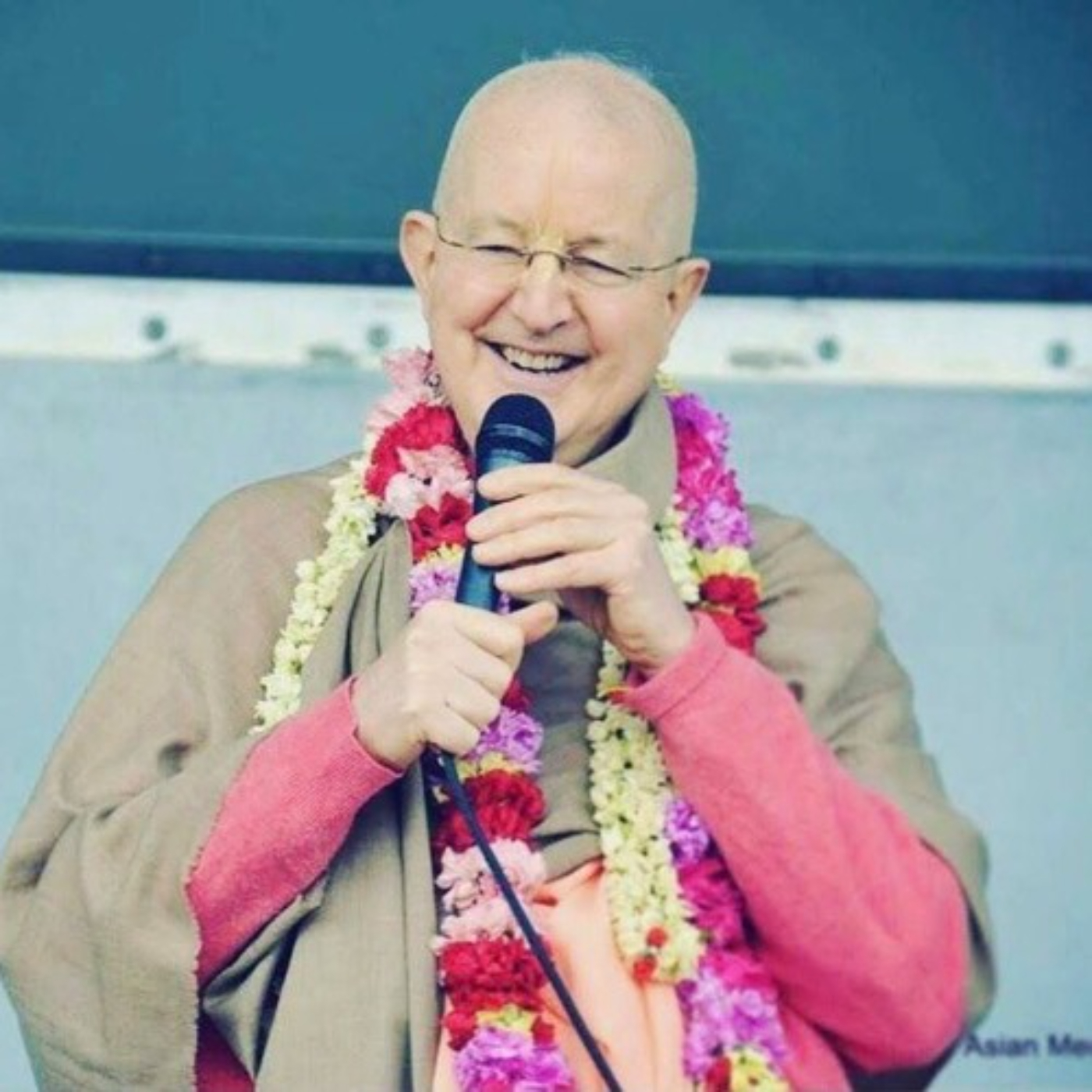
His Holiness Romapada Swami: Gratitude, Love and Devotion to Krishna
His Holiness Romapada Swami is a monk, a spiritual guru, and a senior leader in the International Society for Krishna Consciousness.


About The Episode
Join us on The Founder Spirit podcast with His Holiness Romapada Swami, a revered spiritual leader in the International Society for Krishna Consciousness, who has dedicated his life to sharing bhakti yoga and divine wisdom, illuminating how patience, gratitude, and surrender can unlock your innate love and happiness.
Through captivating stories from his childhood in Upstate New York to teaching from his spiritual master, Srila Prabhupada, discover how synchronicities, heartfelt devotion, and sound vibrations craft a pathway to elevated consciousness. You’ll uncover not only the transformative power of the Mahamantra rooted in ancient Vedic scripture and its relevance in today’s fast-paced world, but also insights from the Bhagavad Gita and the significance of surrender, purity, and shelter in experiencing gratitude, love and inner peace for self-realization.
With reflections on legacy, purpose, and the timeless truth that human life’s ultimate goal is to rekindle our dormant love for the Divine, this episode invites you to reawaken your soul’s forgotten relationship. Whether you're at the start of your spiritual search or seeking deeper clarity, you'll find inspiration to continue your journey with patience, faith, and the mantra that has echoed through the ages.
How did Romapada Swami turn a personal search for truth into a life dedicated to sharing spiritual wisdom globally? TUNE IN to this conversation & find out. Don't forget to subscribe and support us on Patreon!
Biography
His Holiness Romapada Swami is a monk, a spiritual guru, and a senior leader in the International Society for Krishna Consciousness.
Born Brian Rumbaugh, he joined the Krishna consciousness movement in 1971 after encountering the teachings of his spiritual master, Srila Prabhupada. And since then, Romapada Swami has dedicated his life to teaching Bhakti yoga, mentoring spiritual communities, and guiding students worldwide.
For 55 years, he has shared the message of devotion, personal transformation, and practical spirituality across the United States and internationally.
Episode Transcript
[00:02] Jennifer Wu: Hi everyone, thanks for listening to The Founder Spirit podcast. I'm your host, Jennifer Wu. In this podcast series, I interview exceptional individuals from all over the world with the Founder Spirit, ranging from social entrepreneurs, tech founders, to philanthropists, elite athletes and more. Together, we'll uncover not only how they managed to succeed in facing multiple challenges, but also who they are as people and their human story.
Our podcasts are shared freely with the public, and your generosity is highly appreciated as we decided to do away with corporate sponsorships a few years ago. Please consider supporting us on Patreon so that we can continue creating meaningful episodes with inspiring guests - that is P-A-T-R-E-O-N.com/TheFounderSpirit.
As always, you can find us on Apple, Amazon and Spotify, as well as social media and our website at TheFounderSpirit.com.
“Prabhupada had picked me up by the scruff of the neck and shaken me a few times. And I was now in another state of consciousness. And I felt overwhelming gratitude.”
“Gratitude is the seed of love. Purity is the force that moves things in the right direction.”
“We have an eternal intrinsic, at the heart level, at the soul level, a loving relationship that's dormant and forgotten.”
“Loving with all of my body, mind, words, in loving service to the Source of everything, Krishna. That's the purpose - human life's purpose.”
Joining us today is His Holiness Romapada Swami, a monk, a spiritual guru, and a senior leader in the International Society for Krishna Consciousness.
Born Brian Rumbaugh, he joined the Krishna consciousness movement in 1971 after encountering the teachings of his spiritual master, Srila Prabhupada. And since then, Romapada Swami has dedicated his life to teaching Bhakti yoga, mentoring spiritual communities, and guiding students worldwide.
For 55 years, he has shared the message of devotion, personal transformation, and practical spirituality across the United States and internationally.
Just how did Romapada Swami turn a personal search for truth into a life dedicated to sharing spiritual wisdom globally? Well, let’s talk to him & find out.
Hello Your Holiness, thank you for joining us today on The Founder Spirit podcast! Thank you for joining us today out of your busy schedule. We are so honored to have you here with us today.
[02:51] Romapada Swami: Happy to be here and thank you for the honor of being with you.
[02:54] Jennifer: Thank you. Growing up as the youngest of five children in upstate New York, what were some of your formative experiences?
[03:03] Romapada Swami: Well, one of my favorite ones is this - I grew up in a Christian family, in fact, a Protestant family. And my siblings and my mother and father passed on the heritage of their big family of Protestants.
So I did what a little boy growing up in America would do, I went to Sunday school. And what a formative experience was hearing in Sunday school about heaven. And when I came back home, I asked mom and dad, what's it like there? What do people do? (I was) a curious little boy.
And they smiled and they patted me on the head and isn't that cute and all those things, but they didn't have an answer. And I tried a couple of times. And same, it didn't go anywhere. And so I went to the priest and I raised the same question. The priest didn't say I don't know, but he didn't know.
And that was so fundamental to Sunday school. So I continued going to Sunday school, but I stopped asking questions like that because at least I couldn't find anybody that had answers. So that was a formative event.
I have deep regard and memories for things that my mother and father taught me - some things that were just very fundamental. Here's a fundamental one.
One of the things that our family did, growing in upstate New York during harvest season in the fall, we went to places where it was permitted for people… You pay some money, you take a basket and you go pick cherries, fresh, or strawberries or blueberries, we did outdoorsy stuff like that.
Then one of the things my father liked to do, he liked to do gardening. So one fine day, he bought a peach tree, and he planted a peach tree in the backyard. I remember very clearly. And it was like, wow, we don't have to go somewhere to pick peaches; it’s going to be in our backyard.
And there was no peaches the first season, second season. I remember looking at the peach tree. Where's the peaches? And I was told, be patient. So finally, the year before we left, there were these little green things that came out of the peach tree. And I said, there they are. But they didn't mature, they just stayed these little green things. And then we moved.
So I learned a lesson - you got to be patient. Peach trees grow peaches, but you have to be patient. So when it came across teachings of Rupa Goswami that instructed how to progress in spiritual life, the first one was enthusiasm, Utsāha (in Sanskrit), and the next one is be patient.
So how do you be enthusiastic and then at the same time, be patient? You have confidence that the method is going to get you to where you want to go. Peach trees produce peaches - be patient. Just make sure you got a peach tree instead of an apple tree if you want peaches.
[05:50] Jennifer: Right. And make sure that the tree is healthy and not rotten.
[05:54] Romapada Swami: Yeah, you water the root - that's another important thing. It's sunshine and some things that are necessary to make it grow. But you have the right ingredients, and you're going to get the end result.
It's a simple principle, but obviously it stayed with me because it was so many years ago. I remember it very well. Be patient.
[06:13] Jennifer: Your spiritual master, Srila Prabhupada, he is an Indian spiritual teacher and founder of the International Society for Krishna Consciousness, commonly known as the Hare Krishna movement.
And in 1965, at the age of 69, he traveled alone from Calcutta to the United States on a cargo ship with very little money but a trunk full of books, but with a mission to share the teaching of the Bhagavad Gita and the practice of chanting the Hare Krishna Mahamantra.
He hardly knew anyone in the United States, and yet he somehow began teaching Bhakti Yoga in New York City and started attracting a growing community of followers. So I was wondering if you could share with us the story of how you met your spiritual master in 1969?
[07:07] Romapada Swami: Two things. First of all, I never heard his name. I didn't know who he was. I didn't know what he represented.
But the first time was… he was visiting our university. I didn't know that he was visiting. And he was on a tour of universities with Allen Ginsberg. And people in America will know Allen Ginsberg, people outside of America may not know him.
[07:28] Jennifer: He's a poet.
[07:29] Romapada Swami: He's a poet. He's an American poet that was both famous and infamous at the same time. His fame was his poetry, and his infamy or fame was he liked LSD.
So to write his poetry, he took LSD and then wrote his poetry. And it became known as stream of consciousness style, which meant, like, anything that came to his mind which was intoxicated with LSD, that was what his poem was.
And then he went here and there, reading his poetry to people who were similarly intoxicated with LSD or whatever else they were taking. And he was a celebrity, famous and infamous at the same time.
So one of the things that Allen Ginsberg also very much liked was chanting. I didn't know that. I knew about his poetry.
So one fine day, I was walking through the student union of the university that I was attending, I saw a big crowd of people around the Millard Fillmore room, I never saw a crowd of people like that outside the room.
So I kind of wiggled my way through the crowd and went inside to see what's going on. Curious young man. There was a stage, and then everyone was on the floor in front of the stage.
And there were two people on the stage there, right at the spotlight. One was Allen Ginsberg. I recognized him from his big thick glasses and his receding hairline and his hair stuck out like Albert Einstein. I knew him by his face and he was playing bongo drums, I remember very clearly.
And then there was another person next to him whom I didn't know, an elderly Indian man. And together they were singing Hare Krishna, and then the audience was responding to their singing. And that was my first encounter.
I didn't know who he was, I didn't know what the mantra was. I didn't know lots of things, but it was attractive. And because most of the people in the audience were intoxicated with one thing or another, the speaking was also very short.
When they stopped chanting, Srila Prabhupada spoke briefly and then they served a vegetarian dinner. And then it was it, and I didn't stay around for the whole thing. That was my first encounter.
And in retrospect, it was a life-changing experience. That is to say from that particular point in time, events started to happen. In retrospect, I wasn't thinking this is the cause and that's the effect. But there were doors where there weren't doors before.
And I went through this door, that door and found stuff on the other side of the door. And it was an exploration of adventure,
[09:58] Jennifer: Synchronicities.
[10:03] Romapada Swami: Yeah. Finding questions that when I asked when I was a kid, I found answers, and more questions and more answers. And it was a life's experience.
And then there's a detail - but I received a Bhagavad Gita. There's a nice little story, but a short version is version number eight was a gift. And when I read version number eight, it was easy to understand. And the other seven that I had read and couldn't understand.
What's the difference? I kept reading. And then I could understand from the Bhagavad Gita why I could understand one and not the other seven. Because the process of delivering it was a descending one from a higher authority and a line of teachers coming through the ages and just repeating that message. Therefore it was easy to understand.
The message of devotion is descending, not ascending. It doesn't depend on scholarship, it depends on the ears and the capacity to hear and assimilate what one hears from authority.
So that was my introduction to… that many other things happened from that one thing.
[11:05] Jennifer: Well, I feel like sometimes when you're on the right path, somehow synchronicities happen in life, and people or the universe shows you that you're on the right path. I mean, I can relate to my own story.
So basically, I started reading the Bhagavad Gita two or three years ago, only out of curiosity. I had a French serial entrepreneur that was on my show in the first season. And during the first season, I always ask people what their favorite books are, because I'm trying to figure out what I should be reading.
And he was the one who said the Bhagavad Gita. So I picked up whatever was the most popular on Amazon, but I didn't really understand at the time.
One day I finished reading it and I thought, well, some of it I could understand, that God resides in our hearts. But I felt like, oh, I really do need a teacher. And I found this podcast on Spotify (with) Keshava Swami - he's a monk in the London ISKCON Temple, and he's now actually a fellow at the Harvard Divinity School.
And I was so attracted to his teaching. And then a few months later, I met him actually in Davos. Meeting him in person was such a synchronicity just a few months later. So I felt like, oh, I'm really being guided.
And then also around the same time, I had a short interview with Prakash. And I remember, he's like, well, why do you want me on your podcast?
I said, hey, you know what? I actually, I've been asking the same question to your VP of Marketing. But Felix said that I need to interview you, and because you're apparently a spiritual person as well. And he's like, yes, I do teach the Bhagavad Gita online. I said, that's why, that’s why.
So I feel like that throughout the journey, we are always guided. Like the universe kind of shows you all these synchronicities, and you have to be able to tune in and to see them as divine interventions or synchronicities, versus oh, this is like a coincidence, so.
[13:03] Romapada Swami: Coincidence. Chance.
[13:05] Jennifer: Yeah, exactly.
[13:06] Romapada Swami: Well, that's a nice story. And here you are.
[13:08] Jennifer: Yeah. So here I am with you (chuckles).
To continue - so over the next decade of Srila Prabhupada coming to America, he had established over a hundred temples. He wrote and translated dozens of books on Vedic philosophy. And he basically worked tirelessly and traveled around the world throughout U.S. Europe, Asia and Africa. And he initiated several thousand disciples.
He basically, in 12 years, built a global spiritual movement. In your opinion, what were his unique qualities that made him such an extraordinary spiritual leader?
[13:53] Romapada Swami: Three things, to keep it simple. He was empowered. You're empowered to do your podcast, and I'm empowered to go visit universities and stuff like that. He was empowered by the Divine or by Krishna, and that was one.
Another was his unflinching respect and regard and gratitude for his spiritual master, Bhakti Siddhanta, who wanted him to do this. And so that was the fuel in his tank. That's what carried him forward because of love and the mission that was inherited by his spiritual master from previous acharyas (teacher or guru in Sanskrit) without all the detail.
It was a vision and he was entrusted with - here is yours, take it. And over a period of years, in just random discussions, same point, and it went in. So he was carrying that love and the relationship with his spiritual master and empowered by Krishna to do what Krishna wanted him to do.
And a third, in my estimation, he had a clear sense of people are suffering because of ignorance. And he wanted to do something, and he knew what that something was. And if he hadn't done it, you and I and many, many hundreds, thousands of other people would be in la la land just kind of bumping around the universe.
So he wanted people to be happy. And he repeated it. There's a nice Sanskrit phrase - sarva sukho bhavantu sarve sukho. Sukha means happiness - let everyone become happy and no boundaries. Let everyone become happy.
So those are three things - Empowered, dedication, and the blessing of his spiritual master, and his own personal dedication to have people become happy somehow. And he knew this somehow, and so he administered it.
[15:52] Jennifer: Wonderful.
Your Holiness, you were a pre-med student. And I understand that by the time you graduated from the State University of Buffalo, you had decided to forego medical school in favor of a spiritual life.
Was there a particular defining moment behind this decision?
[16:11] Romapada Swami: Yes, I distinctly remember the defining moment. It went like this.
In my senior year of undergraduate studies, I was living with a group of other people that I didn't know before that senior year, just coincidence, divinity. It was all arranged. We all had a spiritual interest of a different flavor without naming the flavors.
And one of the persons who was living with us, they had an interest in Bhakti. And so my interest in Bhakti was nourished by their interest in Bhakti, along with a number of other things.
So we lived in a farmhouse outside the city. And behind the farmhouse was a little cornfield. And so one fine day, I decided to go for a walk early in the morning. And I went through the cornfield and just kept walking and chanting and chanting and chanting.
And I reached the edge of the cornfield and on the other side of the cornfield there was a creek. And when I went to the other side, I looked out and there was a skyline of the city.
There was one of those moments where the world that I used to be in was over there. And the world that I am now in is someplace not over there. And how did I get to this other place? Not just physically, but consciousness wise and purpose of life-wise.
It was Prabhupada had picked me up by the scruff of the neck and shaken me a few times. And I was now in another state of consciousness. And I felt overwhelming gratitude. This is all in a flash, one of those moments.
And I understood an overwhelming feeling of gratitude to having my life completely changed, externally at least, and internally to some degree from where it was and where it was going to where it is today.
A deep breath and I started walking back to the farmhouse, across the field and through the line of trees. And the walk back was in gratitude. I can't just take and not reciprocate, from childhood plus just human nature. You receive a gift, you don't just say thank you, you express it. You do something.
So I thought, what can I do? I’m this little guy, and then I thought Prabhupada risked his life to find unknown people like me in obscure places in upstate New York and changed my life. So let me help him.
And one of the mediums that he established was temples. So let me find a nice temple and dedicate at least some time. So it was not difficult to decide where to go.
I went to Boston as an undergraduate student to check out grad schools. When I went to Boston, I visited the Boston Temple. And without all the detail, it was a special holiday, the exhilaration was otherworldly.
So that was it - I'm going to Boston. And that's what I did after graduation. And my life has been living with the Hare Krishna devotees since.
That was the defining moment - gratitude in one word.
[19:12] Jennifer: I was curious how many devotees were there at that time?
[19:15] Romapada Swami: At that time, it's interesting, ISKCON had no money, so it was a rented building, they put everybody in one building.
It was householders on one floor and ladies over on another floor and single men on another floor. And there were probably 35-40 people living in that single family residential home in the suburbs of Boston, Alston specifically.
And there was no BBT (Bhaktivedanta Book Trust) at that time, ISKCON Press did all the publications. It was only ISKCON, that's all we had. And so all the people that were involved with the press, ISKCON Press, were in the same building.
So all these really nice, from my little vantage point, very senior devotees who I looked up to and learned from and they were fantastic. So that was the scene for one summer. That's where I was in Boston.
[20:10] Jennifer: So I have to tell you about my first encounter with the Hare Krishnas.
I remember the first time that I went to South Street in downtown Philadelphia, and there were a bunch of people parading down the street singing. I was like, who are these people and what are they doing?
They're walking down the street singing and dancing.
[20:32] Romapada Swami: And it's still going on.
[20:33] Jennifer: Yeah, it's still going on.
Going back to some of the spiritual practices. The Mahamantra is the central spiritual practice of ISKCON and a core element of Bhakti tradition within Hinduism. And this mantra is composed of 16 words:
Hare Krishna, Hare Krishna,
Krishna, Krishna, Hare, Hare
Hare Rama, Hare Rama,
Rama, Rama, Hare, Hare.
And I am told it is the devotional call to the Divine, because Hare means divine spiritual energy. And Krishna, of course, is the name of God, and Rama is another name of God.
So I was wondering, what is the deeper meaning of the Mahamantra and where does it come from?
[21:24] Romapada Swami: Nice question. Deeper meaning - you could write a book on the deeper meaning.
So as you indicated, it's a call invoking the spiritual presence of the Supreme. And the part of the mantra that is said eight times out of the 16 times is Hare Krishna, Hare Krishna.
So the Hare in Sanskrit - I'm not a Sanskrit scholar, but this much I know. One of the names of the energy of Krishna is Hara. And in the vocative, Hara becomes Hare. So it's calling Radharani Hare then Krishna, because we worship Radha with Krishna, not Krishna alone.
So Hare Krishna. Oh, energy of Krishna, Hara or Hare, please engage me in the service of your master. So it's a call appealing for service to the Supreme.
And Krishna, the name means to attract or the all-attractive, superlatively attractive. And Rama, the other of the three names, means the reservoir of pleasure - Rama.
So by engaging in the happiness or pleasure that we want in life is through the Supreme, in love. Thus service with love to the Supreme. That's the deeper meaning, one of the ways of explaining rather than writing a book.
[23:00] Jennifer: And actually Rama is just another emanation of Krishna, isn't he? He's not a separate deity.
[23:09] Romapada Swami: Yes, that's correct. Names indicate a feature or an aspect of a person. Just like you have a name and your friends may call you by nickname. You're not a different person.
And similarly, there's one Supreme who is known by different names according to the relationship and the qualities that one appreciates about that person, about the Supreme person.
So Rama, the reservoir of pleasure, there's other meanings of Rama, the source of all strength, Rama, Balarama.
One entity with different names, different features of that one Supreme entity.
[23:48] Jennifer: Got it. And where does the Mahamantra come from? I know there's an interesting story behind it.
[23:54] Romapada Swami: Well, it's simple. In one of the Upanishads, there's tradition and the tradition is rooted in scripture.
And this particular scripture is the Kali-Santaraṇa Upaniṣad, that gives the exact mantra that we chant, the same sequence of the syllables that we chant, indicating that this is the particular means for the age of Kali, for achieving spiritual perfection.
There's a two-part mantra or two-part verse from the Upanishads. That's where it comes from. And then it has been popularized, practiced, and particularly accentuated because it's meant for this age, or it's particularly effective in this age.
[24:32] Jennifer: Okay. So, you know, I had a funny dream about Kali Yuga.
I had a dream that I was given two numbers, or there were two numbers. And it was not a dream with any images, it was just a message.
And Krishna had to add those two numbers and Rama had to subtract one from the other. And so when we multiply those two numbers, then we get the number of years that we still have left in the age of Kali, which is…
[25:00] Romapada Swami: This was a very intricate theme, very intricate.
[25:05] Jennifer: I know. And I shared it with Prakash because you know how technical he is, how much he loves mathematics.
So in that dream state, it made total sense to me. And then I woke up and I'm like, oh, that was a very whimsical dream. But in the dream state, everything made sense to me.
[25:23] Romapada Swami: I don't have dreams of numbers, but you're a special person, so…
[25:26] Jennifer: Yeah, I don't normally dream numbers either, but this one came to me for whatever reason.
Speaking of the Mahamantra, I was wondering, can anyone benefit from chanting the Mahamantra? I know you're supposed to chant it 108 times.
[25:44] Romapada Swami: There's a standard and then there's a principle behind the standard. And so anyone who chants or hears another person chant, or a tree or an insect or bird, the sound vibration is transcendental or beyond the material features of time and space. And the living entity is also… so hearing the sound.
So with practice, there are standards, as you indicated. Certain number of names makes one mantra, certain number of mantras makes, one complete set of a mantra - meditation beads. And so there's ways of counting.
But the most important thing is the sound, not how many.
[26:30] Jennifer: I find that when I chant, well, especially 108 times, it's very purifying. No matter how noisy my mind was before the chant, afterwards it becomes almost a blank sheet.
[26:44] Romapada Swami: You've been chanting probably for many lifetimes (chuckles), a guess.
[26:50] Jennifer: Okay, but that's good to know. That's good to know.
One thing that I haven't figured out, though. You know, I was given the book the Living Name last year by a Hare Krishna friend here in Switzerland.
[27:08] Romapada Swami: Sacinandana Swami - Living Name. I'm familiar with the book.
[27:11] Jennifer: And they say, you know, there's a certain posture, there's, of course, you have to chant with a lot of devotion and then with a lot of love and also attention, with your mind fixed on Krishna.
But the last door can only be opened by God. So that connection, that divine connection, can only be opened...
[27:35] Romapada Swami: Mercy.
[27:35] Jennifer: Yes, by mercy. It goes back to your point about patience. What if in this lifetime, in me or other people, that he never opens the door?
[27:46] Romapada Swami: Persevere. You know, the peach tree will grow peaches. And one who has that faith, on the other side of the door, they know (that) here's a person, a living entity, a soul that has faith.
Here's a little Prabhupada story. Once upon a time I was in Brooklyn at the feet of my spiritual master and he was giving a class on something. And one of the points he was making during the class is embedded in my memory banks.
He said, sometimes you approach Krishna and you appeal, Krishna, please accept me, or like, please open this other door. I know you're there and please be merciful. So Krishna may say, oh, he says he wants me. What about some tribulation? And his voice went up like that.
And the devotee will say to Krishna, you can do with me whatever you want. I only want you, please accept me. And Krishna may think, oh, maybe he does want me. What about a little sense gratification? And his voice again went up.
And then Prabhupada turned his head and said, no, I don't want any of that. I only want you, please give your mercy. And then Krishna may say, oh, maybe he does want me. Let me give myself to him.
So this is the patience. And in the course of being patient, sometimes there's trial, sometimes a trial by fire, sometimes a trial by time. But peach tree grows peaches, or that which is genuine.
So then how do I know what's genuine? That's another nice question. And you know what's genuine? Just like when you're full, when you eat to your capacity, you don't have to have somebody tell you've eaten enough. You can tell them, no, thank you, I'm full.
When you encounter that person or those persons who have that fullness or contentment within, you can feel it and you can feel it within yourself. The same way it doesn't require validation or verification from hooking you up to some machine or something like that. It's subjective.
But there are characteristics of one who has that state of consciousness. And it's predictable, it's very individual, but also in principle, predictable.
The writing in Bhagavad Gita and other parts of the Vedic texts that describe (that). So one can see within oneself and/or within others, are these characteristics there?
[30:20] Jennifer: One thing I did forget to ask you is what was it like being in the presence of your spiritual master?
[30:26] Romapada Swami: Shelter, otherworldly shelter, like the sky can fall in or calamity, anything, it's okay because there's a place of shelter.
Not worrying about or making arrangements for counteracting misery or trying to get something you don't have. It's exactly one of the characteristics (Sanskrit). It's a sense of safety, of real shelter.
One of the things that you probably do, I certainly I do, is meet people who are upside down with their negative emotions or stressed out or all of that. And then boo hoo. And what, please help me, what should I do?
And one of the lessons, this is responsive to your question - what did it feel like? If you have a place of shelter, then everything's okay. And if you don't have a place of shelter, nothing's okay. You try to arrange this and that and the other thing and it's still not okay. The dissatisfaction, the absence of the sense of contentment, prevails, no matter what.
And then when there's shelter, the dualities of material life can't touch you. You experience them, you're aware, but you're in a place of safety and shelter and protection and well-being.
Then your intelligence to decide what to do in this, that or the other circumstance is accessible because the Super Soul is within reach. And if you don't have that place of shelter, good luck. It's a rough ride - endless rough ride.
[31:58] Jennifer: Life is a test, that is for sure.
I totally agree with you - there are people, they're spiritual leaders that I've come across where you just feel love and you feel loved and you feel safe. And again, no matter how noisy your mind is, after being with that person, your mind is blank and you just feel this enormous sense of safety and love.
[32:22] Romapada Swami: Another sense is what I said gratitude - I want to serve, I received. And the love I want to reciprocate with that love that I've received that would express my gratitude in the form of something meaningful to this person.
What can I do that's meaningful? I'm a limited person. I have my psychophysical nature, my capacities. What is it a little person like me can do that's meaningful to this other person as an expression of love?
And then you do that, and then you feel something, you feel a sense of connection with the person. That's love. The medium is the service with love.
[33:04] Jennifer: It's not necessarily visible, of course, but it's a feeling - it's a feeling.
[33:11] Romapada Swami: Yes but generally when the feeling is there, then there's some behavior that goes along with the feeling.
[33:16] Jennifer: That's true.
Now, you mentioned some of your core teachings - one of them is gratitude. Prakash told me that you often say that gratitude is the seed of love. So I was wondering if you wouldn't mind unpacking that for us.
[33:29] Romapada Swami: He likes that phrase because it's one of those truths that…
It goes back to what you asked - was there like an epiphany? So what was that turning point for me? So it was gratitude I've received, it's touched my heart. And certainly as it touched my life, the direction of my life has been reconfigured and I'm feeling very grateful.
Not just like saving me from the precipice of that big skyline of the city over there on the other side of the tree line. But all of what that represents, materialism and pursuing a life of materialism.
Is there an option? And I didn't know what the option was because I didn't find people that understood it or could convey it. But now I knew.
So with gratitude, that's the seed of love, the gratitude. It’s a feeling, and it's also an acknowledgment of having received a gift. And the gift was a voluntary gift. It's not like I went around asking, do you have any gifts for me?
But it's just freely given without my even asking. It was just given. Here, this is yours. And when it's received as it's intended, that's a key. As it's intended, what with the intention, become happy, please. The ignorance of material existence is a cause of suffering.
Before I started getting more involved in Bhakti, one of the persons in this house that I lived in, they were into Buddhism. And so we decided, let's build a little Zendo in our house, so we did.
And long story short, I found A and B, the process was powerful. B, it was unnatural because after the practice of two hours of zazen every morning from the time of sunrise, because as we were told, it's best to do meditation from sunrise.
After sunrise, everything would start to dissipate. That focus, that presence and mindfulness, and all of that being in the moment dissipated. And the reason is it was not natural, there was no shelter.
So I put two and two together and came up with four. There must be a process of meditation where the place that you go to is not nothingness, but somethingness. And a place of real shelter is a person or a loving relationship. So all the pieces of the puzzle fit.
And so I started mantra meditation of different types. And then the one that had the greatest effect was Mahamantra for different reasons.
[36:06] Jennifer: No, it's interesting because a friend of mine practiced that. She was also a guest on the show, and she has been doing Transcendental Meditation now for 20 years every day.
And so with Transcendental Meditation, I understand that you're given a mantra that's suitable or a teacher thinks is suitable for you. I don't know if this is correct, but this is my understanding. And the versus the Mahamantra, which is the universal mantra.
So what is the difference in terms of, for you, as you had tried different types of meditation or different types of mantra meditation, is there one that works for some people versus others?
[36:48] Romapada Swami: Well, that's subjective.
And a couple of comments about Transcendental Meditation and the customized mantra, there was a situation. I wasn't one of them, but some persons who had been doing TM started taking to practice Bhakti and they disclosed what that mantra was.
And the mantra that they received was one of the bija mantras, as in Om Klim Shrim, etc, etc, standard Vedic mantras that generally they introduce a longer string of syllables, but it's an introduction or invocative mantra.
And so customized, that's questionable. Bija mantras or seed mantras, they're universal. And to do it for 20 years, that takes determination. There must have been some experience, because how could someone do something for 20 years without some experience?
So Bija mantras are powerful, just like some people chant Om for a long time. Certain schools of yoga, Gyan Yoga, that's what they do. They chant Om along with other things that they do that's part of their discipline. So it's not a surprise.
But the difference is not just… this is me speaking. My understanding is where's the shelter. If you are invoking, invoking what please. It’s like I say, hey, it's a call.
[33:18] Jennifer: Right, Om.
[33:19] Romapada Swami: Oh, yeah, like that. It's a sound vibration that indicates invoking something.
No, for those that are not personalists, that something is the absolute impersonal or Brahman, the undifferentiated existence of the totality of everything. Om - Pranavah.
It's right in Bhagavad Gita. Praṇavaḥ sarva-vedeṣu śabdaḥ khe pauruṣaṁ nṛṣu (Sanskrit BG7:8 “I am the sacred syllable Om in the Vedic mantras; I am the sound in ether, and the ability in humans.”). It's right in Bhagavad Gita.
So it's an indication of something. But what's behind that something? Is there a person? Yes. So is it universal to just invoke something or the person that's behind the something?
It's a stage of spiritual elevation, like a trajectory. Then you go up into space and you're in space. And then where do you go when you're in space? Is there a destination? And is that destination personal? And if you find a destination that's personal, that's different than just being in space.
It’s the place of shelter, where there's relationship and there's love and there's everything - activity and emotion and experience and knowledge and everything. Sat-Chit-Ananda-Vigraha (Krishna). Everything.
So your question was the difference between something that says it's customized and something that's more on the universal side. I'm just questioning the premise. Customized versus something that's universal for everyone.
The universal for everyone is there's a source of everything. And the source of everything is not just Om. And according to the Vedas, Om is the sound vibration of everything. And then that sound vibration emanates from a Source. And that's a person (Krishna). Now that's teaching.
But the experience of that mantra, the experience of the Hare Krishna mantra are different because the sound vibration indicates something different.
If I just say hey, and you hear that doesn't mean that I've understood you or vice versa, or that I'm doing a service that nurtures a relationship with you. Just hey, vocative.
[40:22] Jennifer: Your Holiness, you have shared Bhakti yoga with a wide range of audiences around the world at temples, but also at Fortune 500 companies like Intel, Microsoft, Cisco and Fannie Mae.
But you remain deeply committed to college outreach and education. This is also where you met Prakash at MIT. And it's a very similar path to the one that I think Jane Goodall took because in her late years she was very committed to spending time with youth.
I was wondering, why is the college outreach and the spiritual education so important to you?
[40:59] Romapada Swami: Well, because it was important to my spiritual master. And then why was it important to my spiritual master? What's behind that?
He wanted to make people happy and he was empowered, but he also wanted to engage other people so that his worldwide mission could expand. And he needed people that had the wherewithal, the guna (attribute) and karma, the quality, the horsepower to help him and provide leadership.
So many, not all, of those leaders came from universities. He was always interested, not just college students, but professors. And he regularly met with such people because intelligent people generally have persons that look up to that intelligent person.
And an intelligent person is meant it's like the brain or the head part of the body. And the head gives direction to the other parts of the body. Without a head, it's a dangerous thing.
So he wanted to help the intelligent people, professors and students, understand what's the purpose of life. And then they, once understanding, could help be instructors to the rest of society.
So it's not like he just restricted himself to that class of people, but it was an important class of people. Same for me. I dedicate, but I do all kinds of other outreach to other kinds of people, just regular old people of different backgrounds and capabilities.
And so it's gratitude because that's what my spiritual master wanted. He wanted a worldwide organization. And it needed people with the cerebral power to understand his message and carry it forward beyond his lifetime.
[42:48] Jennifer: But sometimes those cerebral people reject what they may consider the invisible, though.
[42:55] Romapada Swami: Yeah, that's okay. It takes all types and some people don't, and then some people reject and then they accept and some people accept and then they reject. And it takes all types.
But to have a sustained beyond generational group of intelligent people, not just intellectuals, but intelligent people who could carry the message forward after his life, he saw that as a resource, not the only, but an important resource to do all this.
Just as his spiritual master said, you're an educated young man, please help me.
[43:30] Jennifer: Right. He was given that message to go to the US in his 20s, right? Yeah.
[43:35] Romapada Swami: Yeah, he was a young guy. In the first meeting, first time he had, you're an educated young man, please help. And he carried it again. And so he did it and kaboom. Because he was empowered in addition to having received an instruction.
[43:50] Jennifer: So I want to talk about… a little bit about the Bhagavad Gita, which is a Vedic scripture dating back to the second or first century BC.
And you had mentioned that you read seven different versions of the Gita before you came across Bhagavad Gita As It Is, which is a translation done by Srila Prabhupada.
I was wondering, what is your favorite verse from the Bhagavad Gita?
[44:15] Romapada Swami: Oh, I have a few. You want me to get one or a few?
[44:18] Jennifer: Okay, give me your favorite.
[44:21] Romapada Swami: The last verse of chapter six. The verse describes… it’s a transition verse from the first six chapters to the middle six chapters. Because Bhagavad Gita has 18 chapters, so six and six and six makes 18.
The first six is describing yoga in general while touching on Bhakti. And the last verse is a transition to the middle six where he says he, Krishna, is describing how to perform Bhakti. And then in that verse he mentions - thus far I've described Sankhya, now I'm going to describe Bhakti.
And then in Bhakti it's very simple. That's what the mind does and what the body does. Mind absorbed (in) me, engaged always in my service, surely you will attain me. So then, now I'm going to explain to you how to.
So it's a transition verse that carries a lot of weight, from six chapters into the next six chapters. It's a nice bridge. And to understand what that verse is saying and then how to do what he says he's going to explain how to do helps me keep focus on what the middle six chapters of Bhagavad Gita are intended to do. It's a fulfillment of that last verse of chapter six.
Then a celebrated verse - everyone, many, many people know the 18:66 Bhagavad Gita: sarva-dharmān parityajya. Abandon all prior teachings on Dharma that I've given you and take this one as the principal teaching of all yoga systems or all teachings that I've given so far - that’s “surrender unto Me.”
Very important teaching, 18:66 Bhagavad Gita. So it's also a favorite of mine.
[46:16] Jennifer: So mine is from chapter six and it's verse 30. It's a short one. “For one who sees me everywhere and sees everything in me, I'm never lost and nor is he ever lost to me.”
It's about shelter, taking shelter.
It used to be the one about Karma yoga. In chapter two, verse 47. “You have the right to perform your prescribed duty, but you're not entitled to the fruits of action. Never consider yourself the cause of the result of your activities, and never be attached to not doing your duty.”
The previous favorite verse of mine was on Karma Yoga.
[47:03] Romapada Swami: (in Sanskrit) karmaṇy evādhikāras te mā phaleṣu kadācana - Celebrated verse.
[47:05] Jennifer: Yes, Because I remember at the beginning of the podcast, I was very focused on metrics. (chuckles)
You know, it's kind of like the measure of success. How many people actually listen to my podcast, how many followers I have, and I got into all sorts of metrics. And then after a year, when I read this book, I said, you know what? I need to focus more on the impact and not how many followers I have.
So, speaking of the Bhagavad Gita, the story actually takes place on the battlefield between the Pandava prince Arjuna and his charioteer guide, Krishna, an avatar of Vishnu, a God, against his own family on the other side.
[47:47] Romapada Swami: Well, his relatives.
[47:49] Jennifer: Right, his relatives.
[47:52] Romapada Swami: His brothers were on his side, and the cousins on the other side.
[47:55] Jennifer: That's right, his cousins, his grandfather, his uncle, Teacher. And actually, the Bhagavad Gita is an excerpt from a much longer story, the Mahabharata, I believe.
But the war has been interpreted both as a symbol of the inner struggle between the light and the darkness, between the higher self, I would say, and the lower self, but also a physical one, like the one in the Middle East.
Your Holiness, how does the Kurukshetra battle in the Bhagavad Gita apply to today's world?
[48:31] Romapada Swami: Well, two things. One of the premise preamble statements that you made is certainly how commentators speak about Bhagavad Gita.
But my spiritual master would take exception when people would take - this is not a historical event, this is a symbolic narration so that more common people can understand the struggle between good and evil, external/internal struggles. And it's not really an event. It's a parable, it’s not really history.
Therefore, his title, Bhagavada Gita As It Is, it's a real dialogue with a real event and a real set of circumstances.
Now, the second part of your question, which is, how do the two relate. One is with divine purpose; the other is not with a divine purpose.
A key message in the entire history, Mahabharata history, is, and of the war itself is about Dharma or what is according to the codes of God or the teachings of God, which is Dharma. What is to be done, what is not to be done.
And there is a battle on the basis of Dharma that was given by God and this is to be done. And then there's violators of the codes given by God - and that's Adharma.
And so that's not the current war. The current war is, rather than giving it a label, it’s not that.
[49:59] Jennifer: What is it then?
[50:00] Romapada Swami: Persons that want to control - ishro hum humbogi - in the language of the Sanskrit. Ishra - I want to be a controller, wait a minute, I want to be a controller. And then there's bashing, there’s egos clashing, without God at the center. That's not Dharma.
The cause in Bhagavad Gita, fighting for the right cause is Dharma - anything for the right cause is Dharma. Cooking, walking, breathing, teaching, swimming, exercising, doing business for the right cause - that's Dharma.
And then there's Adharma. Similar looking, but Adharma.
So that's my comment on comparing the two. One was based on Dharma and the other is not. And that there's a consequence of not. If not, there's nobody that's the winner, everyone's a loser.
[50:52] Jennifer: Yes, well, in war, nobody wins anyway.
[50:55] Romapada Swami: But in terms of satisfying the Supreme, nobody wins when the center is missing. And then even if there's good times instead of the war time, something's missing - the essence is missing.
So what's the essence? The Supreme Person is to be pleased. That's our reason for existence, and reason for social interaction is not my gratification versus yours. It's the satisfaction of the Supreme.
As Mother Teresa would say, in the final analysis, it’s not between you and them, it's between you and God anyways. So Mother Teresa in her orphanage in Calcutta, who is to be pleased? Is it Mother Teresa or God?
And she's clear she did what she did, of course, in her own giving, in her own capacity, in her own spirit. But God should be pleased. Now someone could say that, and it's not really, it's about themselves. So it takes purity.
Another example of a nice saying I like besides gratitude is the seed of love is purity is the force that moves things in the right direction. Without purity, it's a mess. And that's what we have.
[52:06] Jennifer: We have a mess. I agree with that.
[52:10] Romapada Swami: And it's not going to get ironed out by calling it a bad name. It's how to restore God-centeredness - that's a big challenge.
And when people have big false egos and they got a club and weapons in their hand, that's very dangerous for themselves and for the people that get in their way.
[52:28] Jennifer: So my friend Andres, who was on the show, he had a very interesting phrase - from ego to we-go.
So how do we go from ego to we-go? But maybe in our case, we go from ego to God consciousness, to Krishna consciousness.
[52:44] Romapada Swami: So it's by sound, the whole in one word, or Shabda Brahman in Sanskrit, spiritual sound vibration. That's how you go from misdirected to properly directed.
We have free will, we have an ego. It can be properly used or misused. And how to get it to proper use? That's the question.
So some people are going to say no and some people are going to say let me think about it. And some people are going to say let me try it. Some people are going to say yes. So there's going to be different responses. So it may be slow and gradual, but that's okay.
Let those persons who want happiness and peace, and Prabhupada's favorite phrase, “peace and prosperity, let them take that remedy that's given through sound in the Vedas and give it a try.”
And when it gives it a try, something happens. The sound vibration that's genuine has an effect. Even for people that are snobs or cruel or harsh or worse, it has an effect. It's not necessarily going to affect everybody globally because some people don't want to hear that sound.
So those people that do want to hear that sound, they're bearers of Krishna Shakti, Krishna's potency. And those who are bearers of Krishna's potency can do Krishna's work more effectively than those that don't.
And then slowly, by/in a cooperative effort, global cooperative effort in different cultures of the world, it can happen.
[54:13] Jennifer: Your Holiness, having dedicated your life to spreading the teachings of Krishna Consciousness, what have you come to understand as the purpose of life?
[54:22] Romapada Swami: To remind us of what we have forgotten - Prabhupada's words. To remind us of what we have forgotten. And what's that? We have an eternal intrinsic, at the heart level, on the soul level, a loving relationship that's dormant and forgotten.
The purpose - re-awaken that dormant, forgotten purpose. Loving with all of my body, mind, words, in loving service to the source of everything, Krishna. That's the purpose - human life's purpose.
[54:56] Jennifer: Beautiful. It reminds me of Dr. Lisa Miller's book called the Awakened Brain.
As you mentioned, you come from a pious Christian family. I was wondering if there are messages from the Bible that you still carry with you.
[55:10] Romapada Swami: Sure. There's a number of them. “Love God with all their heart, with all thy mind, with all thy strength.” Second, “Love thy neighbor as thyself.” And there's verses in the Bhagavad Gita and teachings in the Vedic text that teach the same thing.
Here's another one - “The Father and I are one” - that's interpreted in a certain way. But there's also the statement that says, “God, the Father has sent me”, which indicates two - the one who did the sending and the one who is sent.
So there's oneness between the one who is sent and the one who is sending. And there's a difference - the one who's sending and the one who is sent - the instrument and the wielder of the instrument, or the Son is the representative of the Father.
So there's a oneness between Son and Father, in law as well as in spirit. So those are three teachings that stay with me.
[55:59] Jennifer: There's one that I think of, but it's from the Gnostic Gospels which was found in 1945 in Upper Egypt. It's from the Gospel of Thomas where Jesus says, “if you bring forth what is in you, what you bring forth will save you. If you do not bring forth what is in you. What you do not bring forth will destroy you.”
And it's a verse, I believe, on the Paramatma, on the Super Soul.
[56:29] Romapada Swami: There's a lot of symmetry between different religions and teachings within those different religions. A lot of symmetry.
[56:34] Jennifer: Yes, very much so.
If Srila Prabhupada were with us today, what do you think is the one thing that he would emphasize the most in today's world?
[56:46] Romapada Swami: Well, same thing that he emphasized way back - chant and be happy and Shrinivas Vakrata Krishna Punya.
The message of the Srimad Bhagavatam is meant to cleanse the heart. And those who take to that process of hearing that spiritual sound, their heart becomes cleansed. So please read my books.
I read my books myself, and I understand I'm not the author. Krishna is the author. I was the instrument, the pen, and he was the writer pushing the pen.
So say those three things - Mahamantra - chant and be happy - read my books.
And the difficulty is not putting Krishna at the center. So find ways and means, according to scripture and your teachers and your spiritual master, find ways and means to put Krishna at the center of everything, including your podcast, which you do.
[57:39] Jennifer: I try.
[57:40] Romapada Swami: Yeah well you do.
[57:41] Jennifer: I try, but it's been a journey, it’s been a journey.
[57:43] Romapada Swami: You're doing. You're on the way. You're on the way.
[57:46] Jennifer: Okay, great. Thank you.
We're now coming to the end of our interview, and as you know, we end every episode with a quote. And for this episode, we have a quote from your spiritual master, Srila Prabhupada, an Indian spiritual teacher and the founder of the International Society for Krishna Consciousness:
“The ultimate goal of life is to reach God.”
Your Holiness, many thanks for coming on the podcast today, and inspiring us with your wisdom, humility, and lifelong dedication to sharing the path of Bhakti.
[58:17] Romapada Swami: Thank you.
[58:19] Jennifer: Our podcasts are shared freely with the public, and your generosity is highly appreciated as we decided to do away with corporate sponsorships a few years ago. Please consider supporting us on Patreon so we can continue creating meaningful episodes with inspiring guests - that is P-A-T-R-E-O-N.com/TheFounderSpirit.
As always, you can find us on Apple, Amazon and Spotify, as well as social media and our website at TheFounderSpirit.com.
[58:54] END OF AUDIO
Show Notes
Takeaways:
- Gratitude is the seed of love.
- The power of patience and faith in spiritual growth: Success in spiritual practice hinges on trusting the process, embodying patience, and maintaining confidence that progress is happening, even when visible results are slow.
- The essential role of shelter—spiritually and psychologically: A deep sense of shelter, safety, and love—whether through a relationship, faith, or community—protects the mind from chaos, enabling clarity and resilience.
- Inner purity as the driving force of love and effective transformation: Purity, as a force, moves love and spiritual progress in the right direction; without it, efforts become tangled and ineffective.
- Sound vibration as the universal key to spiritual connection: Spiritual sound—mantras like Hare Krishna—is a universal gateway that shifts consciousness from misdirection to divine love.
- Universal message of love and compassion: Core spiritual messages—such as love of God and compassion—are universal themes across traditions, revealing a shared essence beneath diversity.
- The importance of humility and service in spiritual leadership: True spiritual leadership is rooted in humility, unconditional service, and gratitude to the divine, transcending ego and ego-driven control.
Personal Links:
- Romapada Swami: https://www.romapadaswami.com/
- Wikipedia: https://en.wikipedia.org/wiki/Romapada_Swami
- Instagram: https://www.instagram.com/romapadaswami/
- YouTube: https://www.youtube.com/@RomapadaswamiChannel
Organization & Social Media Links:
- ISKCON Boston: https://iskconboston.org/


